








Why Smart Investors Turn to Physical Gold for Wealth Protection
Investing physical gold offers direct ownership of a tangible asset with no counterparty risk, serving as a proven hedge against inflation and economic uncertainty. Here’s what you need to know to get started:
Quick Guide to Physical Gold Investment:
- Understand the options – Choose between gold coins (easier to sell in smaller amounts) or bars (lower premiums on larger sizes)
- Know the real cost – The spot price plus a dealer premium, typically 1-5% for coins
- Find a reputable dealer – Avoid cold calls and verify credentials through local consumer organizations or state regulators
- Plan for storage – Consider home safes, bank deposit boxes, or third-party vaults
- Factor in all costs – Include storage, insurance, and potential taxes on sales
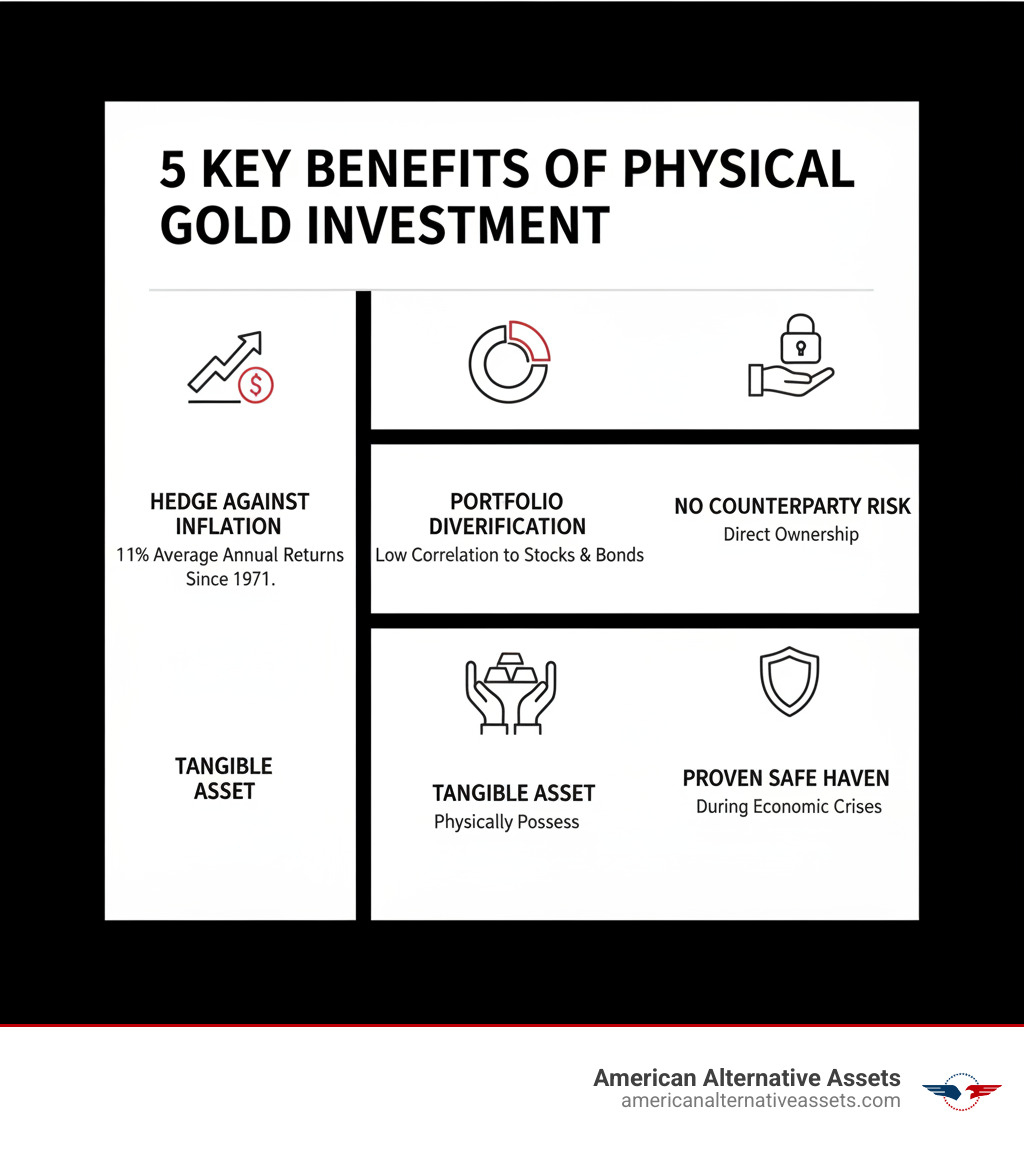
For thousands of years, gold has been a reliable store of value. Since 1971, it has averaged an 11% annual return, outperforming stocks and bonds during five of the last seven major financial crises. But beyond returns, physical gold offers something paper assets can’t: direct ownership without counterparty risk. When you own bars or coins, you aren’t reliant on a fund manager’s decisions or a company’s solvency, making it a powerful tool during economic turmoil.
However, buying physical gold requires diligence. The CFTC has charged companies with over $500 million in fraudulent sales in the last decade, with some charging spreads over 300%. Understanding how to vet dealers, calculate true costs, and plan for storage is critical to protecting your wealth.
Why Choose Physical Gold?
While gold investments include ETFs, mining stocks, and futures, investing physical gold offers unique advantages. The primary benefit is direct ownership. When you buy a gold coin or bar, you own a tangible asset completely, eliminating counterparty risk—the danger that a third party in a transaction will fail to meet its obligations.
Unlike paper assets, which are essentially promises to deliver value, physical gold is wealth you control directly. This provides unparalleled peace of mind, especially during financial crises when promises can be broken. As a timeless store of value recognized for millennia, gold’s worth isn’t dependent on any government or corporation.
This reliability is reflected in its historical performance. Since 1971, gold has averaged an 11% annual return and has outperformed stocks and bonds during five of the last seven major financial crises. Physical ownership also protects you from hacking, platform failures, and ongoing management fees that erode returns on paper-based alternatives. In an abstract digital world, the concrete, enduring nature of physical gold offers real security.
The Appeal of Gold Coins
Gold coins are practical, investment-grade assets that offer unique advantages.
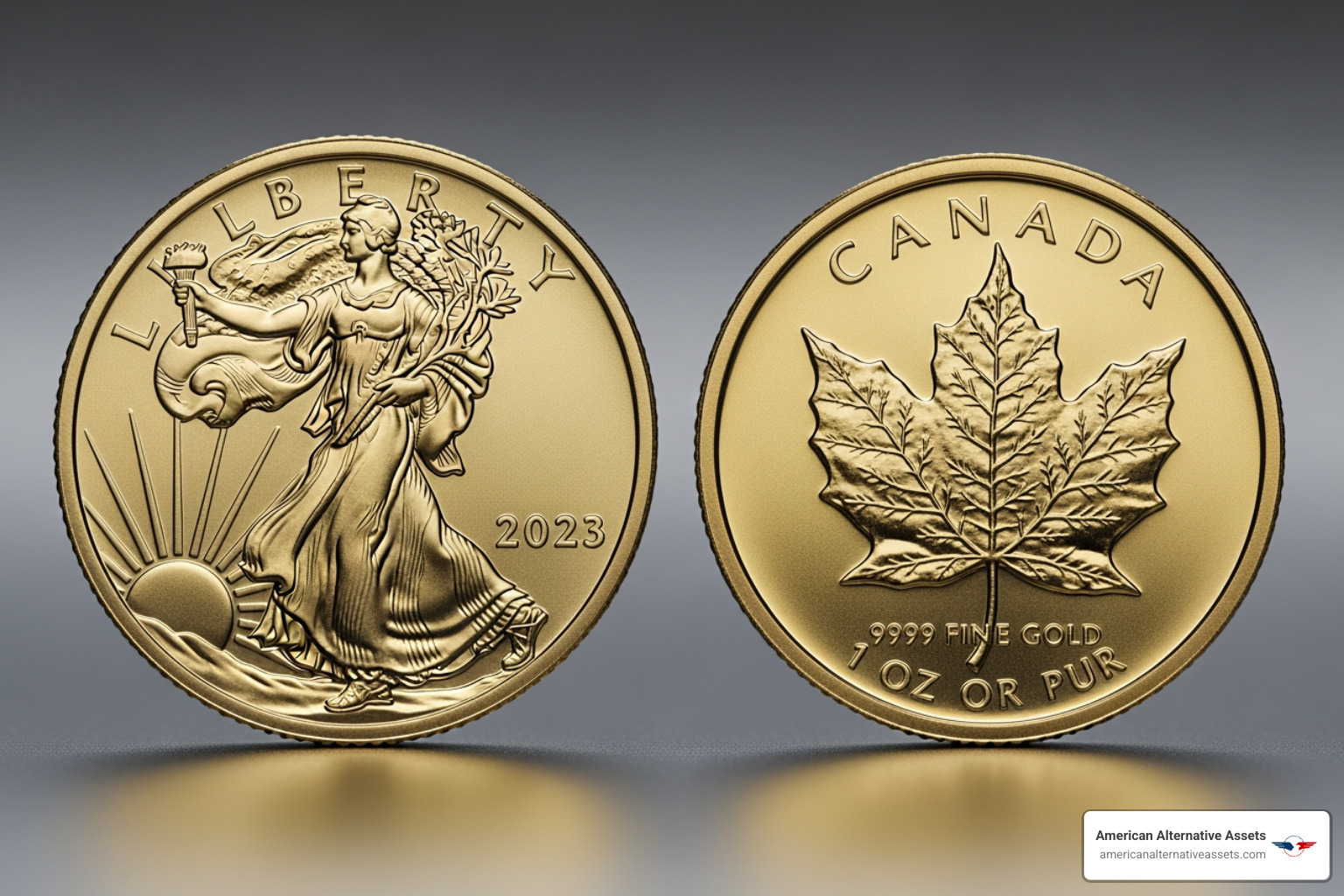
- Flexibility and Liquidity: Coins come in standard weights (e.g., one ounce, half ounce), making them easy to buy and sell in small increments. Popular government-minted coins like the U.S. American Eagle and Canadian Maple Leaf are globally recognized and highly liquid.
- Purity: Purity varies, from the durable 22-karat (91.67% gold) American Eagle to the 24-karat (99.99% gold) Canadian Maple Leaf. Both are excellent investment choices.
- Value: The value of a bullion coin comes from its gold content. Be wary of dealers pushing “semi-numismatic” or collectible coins at inflated prices. For wealth protection, stick to standard bullion coins whose value is tied directly to the price of gold.
The Practicality of Gold Bars
For larger investments, gold bars are a cost-effective choice.
- Lower Premiums: The primary advantage of bars is their lower premium over the spot price, especially for larger sizes like 10-ounce or one-kilogram bars. This means you get more gold for your money.
- Purity and Authentication: Bars from reputable refiners (e.g., PAMP Suisse, Credit Suisse) meet high purity standards (.9999 fine) and come with an assay certificate verifying their weight and purity. This certificate is crucial for resale.
- Efficient Storage: Their uniform shape makes them easy to stack and store efficiently in a safe or vault.
While bars come in various sizes, they are less divisible than coins, making them better suited for substantial, long-term holdings where you don’t anticipate needing to sell small portions.

A Practical Guide to Investing in Physical Gold
Now that we understand why physical gold is a compelling investment, let’s cover how to acquire it. The process involves understanding the price, finding a trustworthy dealer, and securing your asset.
Understanding the Price: Spot, Premiums, and Spreads
The price you pay for physical gold has three main components:
- Spot Price: This is the current market price for one troy ounce of gold. It’s the baseline price you’ll see on financial news sites. For example, on July 26, 2024, the spot price was $2,390 per ounce.
- Premium: You will always pay a premium over the spot price. This covers the costs of minting, shipping, and the dealer’s profit. Premiums are typically 1-5% for one-ounce coins and are lower for larger bars.
- Spread: This is the difference between the dealer’s selling price (their “ask,” which is above spot) and their buying price (their “bid,” which is below spot). A wide spread means the price of gold has to rise significantly just for you to break even. Some fraudulent dealers have charged spreads over 300%, so always compare spreads between reputable dealers before buying.
How to Find and Vet a Reputable Gold Dealer
Finding a trustworthy dealer is critical, as the retail precious metals industry is not federally regulated. The responsibility for due diligence is yours.
Red Flags to Avoid:
- Unsolicited Contact: Never respond to cold calls, random emails, or high-pressure TV and social media ads. Reputable dealers don’t need to use these tactics.
- Lack of Physical Address: Verify the dealer has a real physical address and has been in business for a significant time.
- Refusal to Provide Written Pricing: If a dealer won’t put all fees, costs, and their buy-back price in writing, walk away.
- “Free” Gold or Big Perks: These offers often hide exorbitant spreads and fees.
Questions to Ask Any Dealer Before Buying:
- What is the total price, including all fees, commissions, and costs?
- What is the current spot price of gold you are using for this transaction?
- What is the premium over spot, both in dollars and as a percentage?
- What is your buy-back price (bid price) for this exact item today?
- Can you provide all of this information to me in writing?
- Are your salespeople registered as investment professionals with the CFTC, SEC, or FINRA? (You can verify this yourself using FINRA’s BrokerCheck).
Start your search with established local dealers and check for complaints with your state’s consumer protection agency. For online dealers, do extra research on the company and its owners. At American Alternative Assets, we welcome these questions and are committed to complete transparency.
Secure Storage and Insurance Options
Once you own physical gold, you need a secure storage plan. You have three main options:
- Home Storage: A high-quality, fire-resistant safe offers 24/7 access. However, it carries a risk of theft, and standard homeowner’s insurance policies offer limited coverage for precious metals. You will likely need a special insurance rider.
- Bank Safe Deposit Boxes: This is more secure than home storage and relatively inexpensive. Downsides include access only during banking hours and the fact that contents are not FDIC insured. You must arrange for private insurance.
- Third-Party Depositories: These specialized vaults offer the highest level of security, are fully insured, and are required by the IRS for gold held in a Precious Metals IRA. Your holdings are kept in an “allocated” account, meaning specific bars or coins belong only to you. Fees typically start around 1.5% annually.
Insurance is non-negotiable. Whichever option you choose, confirm you have adequate insurance coverage specifically for your precious metals. The right choice depends on your personal balance of access, security, and cost.
Key Risks and Strategic Considerations
While physical gold is a “safe haven,” no investment is without risk. Understanding these factors helps you make smarter decisions and protect your wealth.
Tax and IRA Strategies for Investing in Physical Gold
The IRS has specific rules for gold investments. When you sell physical gold held for over a year, profits are taxed as collectibles at a maximum rate of 28%, which is higher than standard long-term capital gains.
A powerful strategy to gain tax advantages is a Self-Directed IRA (SDIRA). An SDIRA allows you to hold physical gold in a tax-deferred or tax-free retirement account. You can also roll over funds from existing 401(k)s or other IRAs into a Precious Metals IRA without tax penalties.
The IRS has strict requirements for IRA-eligible gold. It must be high-purity bullion, such as .995 fine gold bars or specific coins like the American Gold Eagle. Collectible coins are not permitted. You can review the IRS rules for precious metals in an IRA for full details.
Crucially, IRA-held gold cannot be stored at home; it must be held by an approved custodian in a secure depository. While custodian fees are higher than for traditional IRAs, the tax benefits can be substantial. Given the complexity, it’s wise to consult a tax professional. At American Alternative Assets, we provide white-glove service to guide clients through this process correctly.
Comparing Physical Gold to Other Gold Investments
When adding gold to your portfolio, you’ll encounter several options beyond investing physical gold. Understanding the key differences is crucial.
| Investment Type | Ownership | Counterparty Risk | Key Costs | Liquidity |
|---|---|---|---|---|
| Physical Gold | Direct ownership of a tangible asset | None | Dealer premium (1-5%+), storage, insurance | Good; depends on finding a dealer |
| Gold ETFs (e.g., GLD) | Shares in a trust that holds gold | Medium; reliant on fund custodian | Expense ratio (0.17%-0.40%), brokerage fees | High; traded like stocks |
| Gold Mining Stocks | Shares in a company | High; subject to company performance, management, and political risk | Brokerage fees, expense ratios for funds | High; traded like stocks |
| Gold Futures | A contract to buy/sell gold at a future date | High; reliant on clearinghouse and counterparty | Brokerage fees, potential for large losses | High; for experienced traders |
- Gold ETFs offer convenience and track the gold price, but you don’t own the actual metal.
- Gold Mining Stocks are bets on companies, not just gold, and come with business-specific risks like labor disputes and management issues.
- Gold Futures are speculative instruments for advanced traders that involve high leverage and risk.
- An interesting alternative is the Sprott Physical Gold Trust (PHYS), which holds allocated physical gold and allows for redemption (with minimums), bridging the gap between ETFs and physical ownership.
If your goal is direct ownership with zero counterparty risk, privacy, and protection against systemic financial failures, physical gold is the superior choice. The costs of premiums and storage are the price for true ownership and peace of mind.
Frequently Asked Questions about Investing in Physical Gold
We know that investing physical gold can feel overwhelming at first. Let’s walk through the most common concerns we hear from investors.
Is it better to buy gold bars or gold coins?
There’s no single right answer; the best choice depends on your goals.
Gold coins (e.g., American Eagle) offer flexibility. Their smaller, standard sizes make them easy to sell in portions if you need to liquidate part of your holdings. This liquidity and global recognition come at the cost of a slightly higher premium over the spot price.
Gold bars are the economical choice for larger investments. The bigger the bar, the lower the premium per ounce, meaning you get more gold for your money. They are also space-efficient for storage. The main drawback is their lack of divisibility; you must sell the entire bar at once.
Many investors use a blended strategy: bars for long-term wealth preservation and coins for liquidity.
How much of my portfolio should I allocate to gold?
The ideal allocation is a personal decision based on your risk tolerance, age, and financial goals. However, research provides a useful guide.
Gold’s low correlation with stocks and bonds means it often performs well when traditional assets fall. Studies show that a 4% to 15% allocation to gold can improve a portfolio’s risk-adjusted returns. Some research suggests an optimal allocation could be as high as 22% for certain long-term strategies.
For most investors, a 5% to 10% allocation is a sensible starting point. This provides meaningful protection against inflation and market turmoil without over-concentrating your portfolio. Gold is a wealth preservation tool, not an income-generating asset. We recommend consulting a financial advisor to determine the right allocation for your unique situation.
Can I lose money when investing in physical gold?
Yes, like any investment, physical gold carries risks and you can lose money. It’s important to have realistic expectations.
- Price Volatility: Gold prices fluctuate daily based on economic data, geopolitical events, and investor sentiment. If you sell during a downturn, you could realize a loss.
- Dealer Spread: You buy gold above the spot price and sell it below. The price must appreciate enough to cover this spread before you can make a profit.
- Ongoing Costs: Storage and insurance fees are ongoing expenses that can eat into returns, especially if the price of gold stagnates.
- Lack of Income: Gold does not pay dividends or interest. Your entire return depends on price appreciation.
These risks are why gold should be viewed as a long-term hedge and a form of wealth insurance, not a get-rich-quick scheme. By understanding these factors and working with reputable dealers, you can use gold effectively to build a resilient portfolio.
Conclusion: Securing Your Future with a Timeless Asset
Investing physical gold is about taking direct control of your financial security. In a world of market volatility and currency devaluation, physical gold stands apart as a tangible asset with no counterparty risk—a proven store of value for millennia.
Whether you opt for the flexibility of coins or the cost-efficiency of bars, you are adding a powerful hedge against inflation to your portfolio. However, knowledge is as crucial as the asset itself. Understanding pricing, vetting dealers, and planning for storage are essential steps to avoid the pitfalls of an industry where fraud is a real risk. A modest 5-15% allocation can improve a portfolio’s long-term, risk-adjusted returns.
At American Alternative Assets, we know your wealth represents your future. Our commitment is to white-glove, relationship-first service built on trust and transparency. We provide real privacy and protection for your assets, free from the high-pressure tactics and hidden fees common in the industry.
If you’re ready to secure your future with the timeless stability of physical gold, we are here to guide you. Learn more about securing your retirement with a Precious Metals IRA and find how American Alternative Assets can help protect your life’s work.