








Why Understanding How to Invest Your IRA Matters More Than Ever

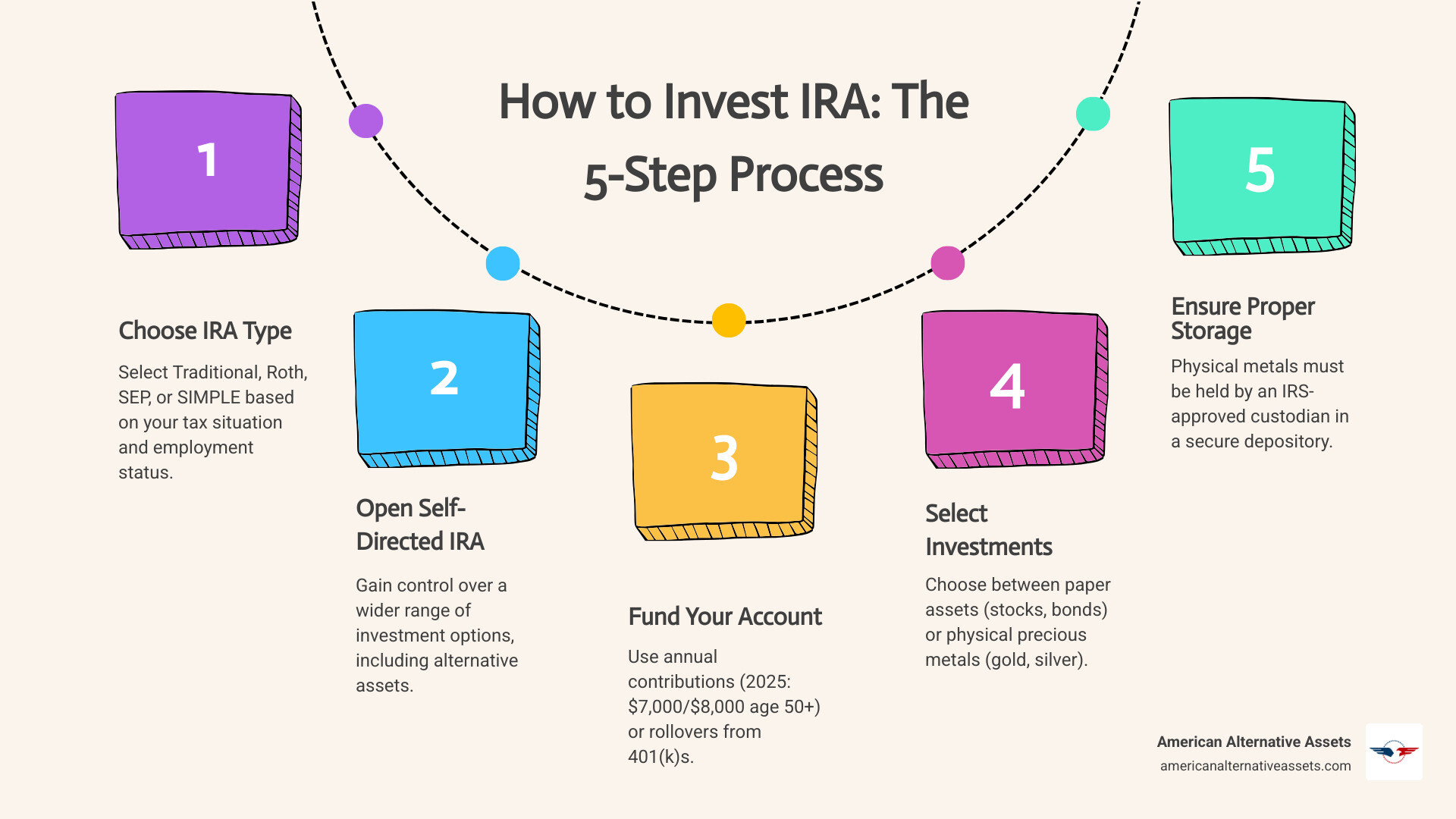
How to invest IRA funds wisely is one of the most important financial decisions you’ll make. Here’s the essential process:
- Choose your IRA type – Traditional, Roth, SEP, or SIMPLE based on your tax situation and employment status
- Open a Self-Directed IRA account – This gives you control over a wider range of investment options
- Fund your account – Through annual contributions, rollovers from 401(k)s, or transfers from existing IRAs
- Select your investments – Choose tangible assets like physical precious metals (gold and silver) to protect your portfolio from the risks of paper assets (stocks, bonds, ETFs)
- Ensure proper storage – Physical metals must be held by an IRS-approved custodian in a secure depository
The stakes couldn’t be higher. Money held in traditional IRAs usually can’t be withdrawn before age 59½ without incurring a 10% federal penalty, on top of ordinary income tax. For 2025, annual contribution limits are $7,000, or $8,000 if you’re age 50 or older. That means every dollar you invest needs to work as hard as possible.
The core question isn’t just whether to open an IRA, but what to put inside it.
Many investors default to paper assets like stocks, bonds, and mutual funds because that’s what their workplace 401(k) offered. But Individual Retirement Accounts give you far more flexibility. With a Self-Directed IRA, you can hold physical precious metals, real estate, and other alternative assets that traditional custodians typically don’t offer.
Physical gold and silver have served as stores of value for thousands of years. Unlike stocks or bonds, they carry no counterparty risk. You’re not depending on a corporation’s performance or a government’s promise. You’re holding tangible assets that have historically maintained purchasing power during times of economic uncertainty.
The difference between paper and physical assets becomes critical during market downturns. When equity markets swing wildly, physical metals in your IRA can provide stability. While paper gold ETFs track the price of gold, they don’t give you the same protection as owning the actual metal stored in a secure depository under your name.
I’m Shanon Davis, and I’ve spent decades in venture capital watching how quickly paper wealth can evaporate, which led me to focus on helping Americans understand how to invest IRA funds in tangible assets that don’t depend on anyone else’s promises. This guide will walk you through the complete process of setting up and managing an IRA that truly works for you.
This article is for informational purposes only and does not constitute financial advice. Please consult your financial advisor before making investment decisions.
What is an IRA and Which Type is Right for You?
An Individual Retirement Account (IRA) is a powerful, tax-advantaged savings vehicle designed to help secure your financial future. IRAs allow for tax-deferred investments, meaning your money can grow without being taxed annually until you take distributions in retirement. This tax shield can significantly boost long-term wealth accumulation.
The main benefit of an IRA is its tax advantage, which varies by type. Unlike a 401(k) offered through an employer, an IRA is an account you open yourself, giving you greater control over investment choices. The IRS provides comprehensive information on Individual Retirement Accounts (IRAs).
There are several types of IRAs, each with unique features for different financial situations:
- Traditional IRA: Contributions may be tax-deductible, leading to immediate tax savings. Earnings grow tax-deferred, and withdrawals in retirement are taxed as ordinary income.
- Roth IRA: Contributions are made with after-tax dollars and are not tax-deductible. However, qualified withdrawals in retirement are completely tax-free.
- SEP IRA (Simplified Employee Pension): Designed for self-employed individuals and small business owners, allowing for much higher contribution limits than Traditional or Roth IRAs. Contributions are made by the employer (even if that’s you), are tax-deductible, and grow tax-deferred.
- SIMPLE IRA (Savings Incentive Match Plan for Employees): A retirement plan for small businesses with 100 or fewer employees, allowing both employee salary deferrals and mandatory employer contributions.
Understanding these distinctions is crucial when deciding how to invest IRA funds to best suit your financial landscape.
Traditional vs. Roth IRA: The Core Decision
Choosing between a Traditional and a Roth IRA often boils down to when you prefer to receive tax benefits: now or in retirement. This is a fundamental decision in how to invest IRA funds.
Here’s a quick comparison of their key features:
| Feature | Traditional IRA | Roth IRA |
|---|---|---|
| Contribution Tax-Deductibility | May be tax-deductible, depending on income and workplace plan | Not tax-deductible |
| Withdrawal Tax Treatment | Taxable as ordinary income in retirement | Tax-free in retirement (qualified distributions) |
| Required Minimum Distributions (RMDs) | Generally start at age 73 (rising to 75 in 2033) | No RMDs for the original owner |
| Income Limits | No income limits for contributions, but limits for deductibility | Income limits apply for direct contributions |
For those who anticipate being in a lower tax bracket now and a higher one in retirement, a Roth IRA can be appealing due to its tax-free withdrawals later. Conversely, if you expect to be in a higher tax bracket now and a lower one in retirement, the immediate tax deduction of a Traditional IRA might be more beneficial.
IRAs for Business Owners and the Self-Employed
For entrepreneurs and the self-employed, SEP and SIMPLE IRAs offer powerful ways to save for retirement with significantly higher contribution limits. These plans are designed to help maximize retirement savings while providing tax advantages.
- SEP IRA: This plan allows you to contribute a substantial portion of your income. For 2024, the SEP IRA contribution limit is 25% of total compensation or $69,000, whichever is less. Contributions are made by you as the employer to an IRA for each employee (including yourself). The contributions are tax-deductible, reducing your current taxable income. The IRS provides specific guidelines for IRS rules for self-employed contributions.
- SIMPLE IRA: This plan is for businesses with 100 or fewer employees. It allows employees to make salary reduction contributions, and the employer makes matching or non-elective contributions. For 2024, the contribution limit for a SIMPLE IRA is $16,000. It offers a straightforward way to provide retirement benefits.
These specialized IRAs are valuable tools when planning how to invest IRA funds for those who run their own businesses, offering flexibility and greater savings potential.
The Most Important Choice: Physical Assets vs. Paper Investments
When we consider how to invest IRA funds, we face a fundamental choice: do we invest in paper assets, or do we seek the enduring value of physical assets? For us, the answer is clear: physical precious metals offer unparalleled stability and protection for our wealth.

Many investors are accustomed to filling their IRAs with paper assets like stocks, bonds, mutual funds, and ETFs. While these can offer growth potential, they also come with inherent vulnerabilities. At American Alternative Assets, we believe in true diversification, which means moving beyond the traditional paper markets and embracing the long-term value of tangible assets.
Physical gold and silver stand apart because they carry no counterparty risk. This means their value isn’t dependent on the solvency of a corporation, the stability of a government bond, or the performance of a fund manager. We hold the asset directly, through a secure custodian, giving us real privacy and protection for our wealth. This is a critical distinction, especially in uncertain economic times.
Why Paper Assets Can Introduce Risk
Paper assets, by their very nature, are promises or representations of value, not intrinsic value themselves. When we invest in stocks, we own a tiny piece of a company, subject to its performance, market sentiment, and broader economic forces. Bonds, while often seen as safer, carry their own risks. Bond funds, for instance, are subject to the risk that an issuer will fail to make payments on time, and that bond prices will decline because of rising interest rates or negative perceptions of an issuer’s ability to make payments.
Even diversified paper investments like mutual funds and ETFs, which pool money from many investors to buy a mix of securities, are still exposed to market fluctuations and the inherent volatility of their underlying paper holdings. Target-date funds, designed to adjust asset allocation over time, are also subject to the risks of their underlying funds. An investment in target-date funds is not guaranteed at any time, including on or after the target date.
The reliance on paper assets means our retirement savings are constantly exposed to the whims of the market, corporate performance, and geopolitical events. This introduces a level of uncertainty that many of us are increasingly uncomfortable with, especially as we approach retirement.
The Case for Tangible Assets in Your IRA
The enduring appeal of tangible assets, particularly physical precious metals like gold and silver, lies in their historical role as a store of value. For millennia, gold has been recognized as a universal currency and a hedge against inflation and economic instability.
When we invest in physical precious metals within our IRA, we are investing in assets that:
- Have intrinsic value: Unlike paper currency or digital assets, gold and silver possess inherent worth, independent of any government or financial institution.
- Offer protection against currency devaluation: As fiat currencies lose purchasing power over time, precious metals tend to maintain or even increase their value, safeguarding our wealth.
- Carry no counterparty risk: We own the actual metal, stored securely, rather than a promise from a third party. This eliminates dependence on the financial health of banks or corporations.
- Provide true diversification: Physical precious metals often have a low correlation with traditional paper assets like stocks and bonds. This means they tend to perform well when other assets are struggling, providing stability to our overall portfolio. Investing and Diversification resources from the Department of Labor highlight the importance of spreading risk.
At American Alternative Assets, we specialize in helping our clients understand how to invest IRA funds in physical precious metals. Our white-glove, relationship-first service is built on trust, transparency, and ethical practices, ensuring real privacy and protection for your wealth. We believe that incorporating tangible assets into your IRA is not just an investment strategy, but a proactive step towards financial preparedness and peace of mind.
How to Invest IRA with Physical Precious Metals
For those of us seeking to diversify our retirement portfolios beyond traditional paper assets, a Self-Directed IRA (SDIRA) offers the flexibility to invest in physical precious metals, such as gold and silver. This specialized IRA, often referred to as a Gold IRA or Silver IRA, allows us to hold tangible assets that are otherwise unavailable in standard IRAs.
The process of how to invest IRA funds in precious metals involves working with a specialized custodian and ensuring our chosen metals meet IRS eligibility requirements.
Step 1: Open a Self-Directed IRA
The first crucial step to investing in physical precious metals for our retirement is to open a Self-Directed IRA (SDIRA). Unlike traditional IRA providers that limit us to stocks, bonds, and mutual funds, an SDIRA empowers us to hold a broader range of alternative assets, including real estate, private equity, and, most importantly for us, physical gold and silver.
Choosing the right custodian for our SDIRA is paramount. We need a custodian experienced in handling alternative assets, particularly precious metals, as they are responsible for ensuring compliance with IRS regulations and facilitating the secure storage of our physical assets. Our team at American Alternative Assets can guide you through the process of selecting an appropriate custodian, streamlining the account setup, and managing the necessary paperwork. We ensure that our clients receive white-glove, relationship-first service, built on trust and transparency from the very beginning.
To get started, we can explore resources on how to open an IRA, keeping in mind that for precious metals, a Self-Directed IRA will be required.
Step 2: Fund Your Precious Metals IRA
Once our Self-Directed IRA is established, the next step is to fund it. There are two primary ways to do this: through annual contributions or by rolling over funds from an existing retirement account.
- Annual Contributions: We can contribute directly to our SDIRA each year, up to the IRS-mandated limits. For 2025, the annual contribution limit for IRAs is $7,000. If we are age 50 or older, we can make an additional “catch-up” contribution of $1,000, bringing our total to $8,000.
-
Rollovers: This is a very common and effective way to fund a Precious Metals IRA, especially for those with substantial savings in employer-sponsored plans. We can roll over funds from existing retirement accounts such as a 401(k), 403(b), TSP, or even another IRA. The IRS provides a helpful rollover chart from IRS for more information on eligible rollovers.
- Direct Rollover: The most straightforward method, where funds are transferred directly from our old plan administrator or custodian to our new SDIRA custodian. This avoids any temporary possession of funds and potential tax implications.
- Indirect Rollover: We receive a check for our retirement savings and have 60 days to deposit it into our new SDIRA. If we miss this 60-day window, the distribution becomes taxable and may incur penalties. The IRS generally limits us to one indirect rollover from an IRA to another IRA within a 12-month period.
Our team at American Alternative Assets assists clients in Woodland Hills, CA, and across California, USA, with navigating the rollover process, ensuring it’s seamless and compliant with all IRS regulations.
Step 3: A Guide on How to Invest IRA Funds in Eligible Metals
With our Self-Directed IRA funded, we can now proceed to the exciting part: selecting and purchasing our physical precious metals. This is where understanding how to invest IRA funds in tangible assets truly comes into play.
- Purchasing Gold and Silver: We will work with you to select IRA-eligible gold and silver products. Not all precious metals are allowed in an IRA. The IRS has specific requirements to ensure the purity and type of metals are acceptable.
- IRA-Eligible Coins and Bars: Generally, gold coins and bars must have a minimum fineness of .995 (99.5% pure gold), and silver must have a fineness of .999 (99.9% pure silver). Notable exceptions include American Gold Eagle coins, which are .9167 fine but are specifically approved by the IRS. Other popular eligible items include American Silver Eagles, Canadian Gold and Silver Maple Leafs, and various gold and silver bars from approved refiners. Our specialists ensure that every product you choose meets these strict IRS guidelines.
- Secure Storage: A critical aspect of a Precious Metals IRA is secure storage. The IRS strictly prohibits us from storing our IRA-held precious metals at home. All physical assets must be held by a third-party, IRS-approved custodian in a secure, non-bank bullion depository. This ensures the integrity of the tax-advantaged status of our IRA. Taking physical possession of our metals outside of a qualified distribution is considered a taxable event and may result in penalties. We partner with highly secure, insured depositories to safeguard our clients’ assets, providing peace of mind.
Understanding IRA Rules, Limits, and Distributions
Understanding the rules and regulations governing our IRA is just as important as knowing how to invest IRA funds. These rules, set by the IRS, cover everything from how much we can contribute annually to when and how we can withdraw our money without penalties.
Navigating contribution limits, potential penalties for early withdrawals, and Required Minimum Distributions (RMDs) can seem complex, but with proper guidance, we can ensure our IRA remains compliant and continues to grow effectively.
IRA Contribution and Withdrawal Rules
- Annual Contribution Limits: The IRS sets annual limits on how much we can contribute to our Traditional and Roth IRAs. For 2025, this limit is $7,000.
- Age 50+ Catch-Up Contributions: To help us boost our retirement savings as we near retirement, the IRS allows an additional “catch-up” contribution for those age 50 and older. For 2025, this catch-up contribution is an extra $1,000, bringing the total to $8,000.
- 10% Early Withdrawal Penalty: Generally, money held in an IRA cannot be withdrawn before age 59½ without incurring a hefty tax penalty of 10% of the amount withdrawn. This is in addition to ordinary income tax on the withdrawn amount. This rule applies to Traditional IRAs.
- Exceptions to the 10% Penalty: There are some specific circumstances where we may be able to withdraw funds from our IRA before age 59½ without incurring the 10% penalty. These exceptions can include expenses for higher education, qualified first-time home purchases, certain unreimbursed medical expenses, and distributions due to disability. We can find more details on these exceptions to the 10% penalty.
- Roth Contribution Withdrawal Rules: A significant advantage of a Roth IRA is that we can withdraw our original contributions (the money we put in, not the earnings) at any time, tax and penalty-free. However, if we withdraw earnings before age 59½ or before the account has been open for five years, those earnings may be subject to ordinary income tax and the 10% federal penalty tax.
Navigating Required Minimum Distributions (RMDs)
Required Minimum Distributions (RMDs) are amounts that Traditional, SEP, and SIMPLE IRA account owners must begin to withdraw from their retirement accounts each year once they reach a certain age. These distributions are mandatory and ensure that the IRS eventually collects tax revenue on the tax-deferred growth.
- RMD Age: As of January 1, 2023, Traditional IRA account holders must begin taking RMDs in the year they turn age 73. The age for required minimum distributions will rise to 75 in 2033.
- Traditional IRA RMDs: For Traditional IRAs, the RMD amount is calculated based on our account balance at the end of the previous year and our life expectancy, as determined by IRS tables. These distributions are taxed as ordinary income.
- Roth IRA RMD Exemption: One of the key advantages of a Roth IRA is that the original owner is not required to take RMDs during their lifetime. This allows our funds to continue growing tax-free for as long as we live, and potentially for our beneficiaries.
- Penalty for Missed RMDs: Failing to take our RMD by the deadline can result in a significant penalty. The penalty for missing an RMD is generally 25% of the amount that should have been withdrawn, but it can be reduced to 10% if the mistake is corrected within the allowed time frame. It is crucial to understand and adhere to RMD rules to avoid these penalties.
Our commitment at American Alternative Assets is to help our clients understand these complex rules, ensuring they are well-informed as they learn how to invest IRA funds in a compliant and beneficial manner.
Frequently Asked Questions about Investing in an IRA
We understand that navigating IRAs can bring up many questions. Here, we address some of the most common inquiries our clients have when learning how to invest IRA funds for their retirement security.
Can I hold physical gold in my IRA at home?
No, IRS regulations strictly prohibit home storage of IRA-held precious metals. The assets must be held by a third-party custodian in a secure, approved bullion depository to maintain their tax-advantaged status. Taking physical possession is considered a distribution and may incur taxes and penalties. This rule is in place to prevent misuse and ensure the assets are properly valued and accounted for. We partner with established, highly secure depositories to ensure our clients’ precious metals are stored safely and compliantly.
What is the difference between an IRA and a 401(k)?
The primary difference lies in control and sponsorship. A 401(k) is an employer-sponsored retirement plan, meaning your investment options are chosen and managed by your employer or their chosen plan administrator. While 401(k)s can offer benefits like employer matching contributions, they often have a limited selection of investment choices.
An IRA, on the other hand, is an individual account that you open and control directly. This provides a much wider range of investment choices. With a Self-Directed IRA, this control extends to alternative assets like physical precious metals, real estate, and more. This flexibility allows us to tailor our retirement portfolio precisely to our financial goals and risk tolerance, something often not possible with a standard 401(k).
How does age affect my IRA investment strategy?
Age plays a significant role in traditional investment advice, often suggesting that younger investors with a longer time horizon can tolerate more growth-oriented assets like stocks. As we approach retirement, the conventional wisdom shifts toward capital preservation, advocating for a more conservative allocation to bonds and less volatile investments.
However, when considering physical precious metals, the strategy can be viewed differently. Holding assets like physical gold and silver can be a prudent strategy at any age. For younger investors, precious metals can act as a long-term hedge against inflation and currency debasement, preserving purchasing power over decades. For those nearing or in retirement, precious metals provide a stable foundation, safeguarding accumulated wealth against market volatility and economic uncertainty. Physical assets offer a unique form of diversification that improves portfolio resilience, providing benefits regardless of our age or time horizon.
Secure Your Future with a Diversified IRA
As we have explored, understanding how to invest IRA funds wisely is a cornerstone of a secure retirement. The choice between paper assets and physical precious metals is a critical one, and we firmly believe in the enduring value and protective qualities that tangible assets offer.
Our goal at American Alternative Assets, serving clients in Woodland Hills, CA, and throughout California, USA, is to empower you to take control of your retirement security. By embracing a diversified long-term strategy that includes physical precious metals within a Self-Directed IRA, we can move beyond the volatility of traditional markets and build a foundation of wealth preservation. We are committed to providing white-glove, relationship-first service, built on trust, transparency, and ethical practices, ensuring real privacy and protection for your wealth.
We encourage you to consider the benefits of adding physical gold and silver to your retirement portfolio. It is a proactive step towards safeguarding your financial future, providing peace of mind in an ever-changing economic landscape.
Learn more about protecting your retirement with a Precious Metals IRA
This article is for informational purposes only and does not constitute financial advice. Please consult your financial advisor before making investment decisions. Investing in precious metals involves risk. Past performance does not guarantee future results.
This article is for informational purposes only and does not constitute financial advice. Please consult your financial advisor before making investment decisions.
Investing in precious metals involves risk. Past performance does not guarantee future results.