








Why Precious Metals IRAs Matter for Your Financial Future
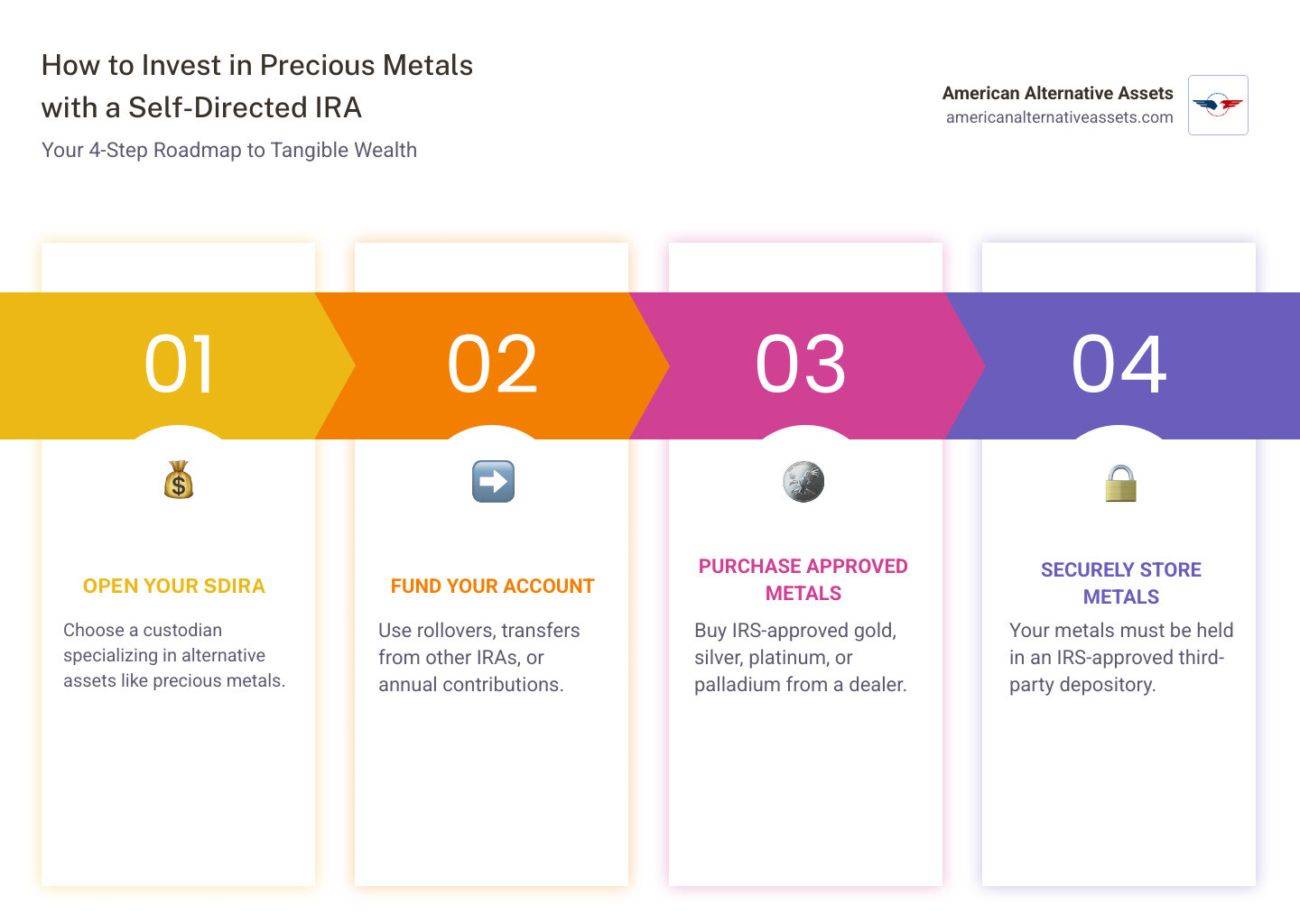
As traditional markets show increasing volatility, more Americans are asking how to invest in precious metals with a self-directed ira. The process is straightforward and involves four key steps:
- Open a Self-Directed IRA with a custodian that allows precious metals investments.
- Fund your account through a rollover, transfer, or contribution.
- Purchase IRS-approved metals like gold, silver, platinum, or palladium.
- Store your metals in an IRS-approved depository.
Physical precious metals represent tangible wealth. Unlike paper assets, their value isn’t tied to a company’s performance or a government’s promise. While most IRAs limit you to stocks and bonds, a Self-Directed IRA opens the door to holding physical gold and silver. These are assets that have preserved wealth for thousands of years, and with an SDIRA, you own the actual metal.
The appeal is simple. Physical precious metals don’t carry counterparty risk. They can’t be devalued by monetary policy or erased by a computer glitch. And when held in a Self-Directed IRA, they grow tax-deferred or even tax-free, depending on your account type.
Recent economic uncertainty, from inflation to market swings, has reminded investors of the importance of diversification. Precious metals offer a way to protect purchasing power while enjoying the tax advantages of a retirement account.
The IRS allows physical gold, silver, platinum, and palladium in IRAs, provided specific rules are followed. The metals must meet purity standards and be stored in an approved depository. Personal possession is not allowed.
This guide walks you through the entire process, from understanding what a Self-Directed IRA is, to selecting the right metals, to ensuring full IRS compliance. We’ll cover the rules, the benefits, and the practical steps you need to take.
I’m Shanon Davis, founder of American Alternative Assets. After decades in finance, I’ve seen the importance of diversifying beyond traditional systems. This guide provides a clear roadmap for securing your retirement with tangible assets.
Understanding the Power of a Precious Metals IRA
A Self-Directed IRA (SDIRA) gives you control over your retirement investments, allowing you to hold alternative assets like physical precious metals. Unlike a traditional IRA, which is often limited to stocks and bonds, an SDIRA lets you diversify your portfolio with tangible assets. The core difference lies in investment control. With an SDIRA, you are in the driver’s seat, choosing what investments to hold, while a custodian administers the account and ensures IRS compliance.
Why Choose Physical Metals for Your Retirement?
When learning how to invest in precious metals with a self-directed ira, it’s important to focus on physical ownership—actual gold and silver coins and bars—not paper assets. While you can gain exposure to precious metals through exchange-traded funds (ETFs) or mining stocks in a traditional IRA, these are fundamentally different from owning the physical metal itself.
Physical precious metals offer tangible asset security. They are not a promise to pay, like a stock or bond, but the asset itself. This means they carry no counterparty risk, a significant advantage in times of economic uncertainty. If a bank or brokerage firm faces difficulties, your physical metals, held securely in a depository, remain yours. This direct ownership provides a level of control over your assets that paper investments simply cannot match.
Throughout history, gold, in particular, has been renowned for its potential for steady appreciation and its role as a stable store of value. It has consistently served as a hedge against currency devaluation and inflationary pressures, helping to preserve purchasing power over the long term. This makes physical precious metals a compelling choice for those seeking to safeguard their retirement savings.
The Key Benefits of Holding Precious Metals in an SDIRA
Investing in physical precious metals within an SDIRA offers a unique combination of benefits for your retirement planning:
- Tax-Advantaged Growth: Just like traditional IRAs, an SDIRA allows your investments to grow tax-deferred. This means you don’t pay taxes on gains until you withdraw funds in retirement. If you choose a Roth SDIRA, your qualified withdrawals in retirement can be entirely tax-free.
- Portfolio Diversification: Precious metals often move independently of traditional stock and bond markets, offering a valuable diversification tool. Adding metals to your portfolio can potentially smooth out returns and reduce overall risk, especially during periods of market volatility.
- Inflation Hedge: Historically, precious metals, especially gold, have acted as a hedge against inflation. During inflationary periods, when the purchasing power of fiat currencies declines, the value of gold often rises, helping to protect your wealth.
- Economic Uncertainty: In times of geopolitical instability or economic crisis, precious metals are often seen as a “safe haven” asset. Investors tend to flock to gold and silver when confidence in other assets wanes, providing a potential buffer for your retirement savings.
- Protection of Purchasing Power: By holding tangible assets with intrinsic value, you can better protect your purchasing power against currency fluctuations and the long-term erosion of paper money’s value.
How to Invest in Precious Metals with a Self-Directed IRA: A Step-by-Step Guide
Starting on the journey of how to invest in precious metals with a self-directed ira is a straightforward process when broken down into a few key steps. Our team at American Alternative Assets is here to guide you through each stage.
Step 1: Open and Fund Your Self-Directed IRA
The first step is to open an SDIRA with a custodian that specializes in precious metals. Unlike traditional brokerages, these custodians are equipped to handle the specific IRS regulations for holding physical assets in a retirement account.
- Choosing a Specialized Custodian: We recommend selecting a custodian with experience in SDIRAs and precious metals. They will administer your account, ensure compliance with IRS rules, and facilitate transactions with precious metals dealers and depositories.
- Account Application: The process begins with completing an SDIRA application form with your chosen custodian.
- Funding Methods: Once your account is open, you need to fund it. There are several ways to do this:
- Rollovers from 401(k) or other IRAs: You can roll over funds from an existing retirement account, such as a 401(k) from a previous employer or another IRA. A direct rollover, where funds move from one custodian to another, is a simple, tax-free way to fund your new SDIRA.
- Annual Contributions: You can also fund your SDIRA with new contributions. The IRA contribution limits for 2025 are $7,000 for individuals under 50 and $8,000 for those aged 50 or older. These limits apply across all your IRAs.
- Direct Transfers: If you have an existing IRA, you can initiate a direct transfer of funds to your new SDIRA custodian.
Our team can help you understand the nuances of funding your SDIRA, ensuring a smooth and compliant transfer of your retirement assets.
Step 2: Select Your IRS-Approved Precious Metals
With your SDIRA funded, the next step is to select the precious metals you wish to hold. This involves working with a reputable precious metals dealer and ensuring your chosen metals meet strict IRS requirements.
- Working with a Reputable Dealer: We emphasize working with a trusted precious metals dealer. They will help you identify IRS-approved products and facilitate the purchase. It’s essential to conduct due diligence on any dealer, checking their reputation and pricing transparency.
- IRS-Approved Metals: The IRS has specific purity criteria for precious metals allowed in an SDIRA:
- Gold: Must have a minimum purity of 99.5%.
- Silver: Must have a minimum purity of 99.9%.
- Platinum: Must have a minimum purity of 99.95%.
- Palladium: Must have a minimum purity of 99.95%.
- Bullion Bars and Coins: Eligible items include bullion bars and rounds from approved refiners, as well as specific government-minted coins like American Eagles, Canadian Maple Leafs, and Australian Kangaroos.
- Due Diligence on Dealers: Your SDIRA custodian will process the transaction, but you are responsible for choosing the dealer and verifying that the products they offer meet IRS standards. We recommend asking dealers about their experience with SDIRAs and their process for coordinating with custodians and depositories.
Step 3: Purchase and Store Your Metals
Once you’ve selected your precious metals and dealer, the final stage involves the purchase and secure storage of your assets.
- Executing the Purchase: You will instruct your SDIRA custodian to purchase the metals from your chosen dealer. The custodian will then issue payment directly to the dealer from your SDIRA funds.
- Custodian-to-Dealer Transaction: The transaction occurs between the custodian and the dealer, ensuring compliance, as the custodian is the legal owner of the IRA assets.
- Shipping to a Secure Depository: After the purchase, the dealer will arrange for the secure shipment of your precious metals to an IRS-approved depository. This is a non-negotiable requirement for holding physical precious metals in an IRA.
- Segregated vs. Non-Segregated Storage: Depositories offer two main storage options:
- Non-segregated (or commingled) storage: Your metals are stored alongside identical metals from other investors. This is generally a more cost-effective option.
- Segregated storage: Your specific precious metal items are kept separate from all other holdings, guaranteeing that you receive the exact items you deposited when you take a distribution. This option typically incurs higher storage fees.
- Taking Delivery is Prohibited: As per IRS regulations, you cannot take personal possession of the precious metals held within your SDIRA. Doing so would be considered a taxable distribution and could result in penalties.
Navigating IRS Rules for Precious Metals IRAs
Understanding and adhering to IRS regulations is paramount when learning how to invest in precious metals with a self-directed ira. Compliance ensures that your precious metals investments retain their tax-advantaged status within your retirement account. Ignoring these rules can lead to severe penalties and the loss of your IRA’s benefits.

IRS Purity and Type Requirements
The IRS is quite specific about what types of precious metals qualify for an IRA. To be eligible for IRA ownership, precious metals must meet specific fineness standards and generally be produced by an approved mint or refiner.
- Gold Purity Standard: Gold must have a minimum purity of 99.5%. An important exception is the American Gold Eagle coin, which is 22-karat (.9167 fine) but specifically allowed by the IRS.
- Silver Purity Standard: Silver must have a minimum purity of 99.9%.
- Platinum and Palladium Purity Standard: Both platinum and palladium must have a minimum purity of 99.95%.
These IRS rules for IRA-approved metals ensure the metals are investment-grade bullion, not collectibles. Most rare or numismatic coins are considered collectibles and are not permitted in an IRA. Purchasing ineligible products can result in the transaction being treated as a taxable distribution, so it’s crucial to select only approved bullion coins and bars.
The Mandate for Third-Party Storage
Perhaps the most critical IRS regulation for precious metals IRAs is the requirement for third-party storage. This rule is often misunderstood, and non-compliance can lead to significant issues.
- IRS-Approved Depository Requirement: The IRS mandates that all physical precious metals held within an IRA must be stored in an IRS-approved depository. These facilities are highly secure, insured, and regulated, ensuring the safety and integrity of your assets. They act as a neutral third party, holding your metals on behalf of your IRA custodian.
- Personal Possession is a Taxable Distribution: You, as the IRA owner, cannot take personal possession of your IRA-owned precious metals. Doing so is considered a taxable distribution and may incur significant penalties. This rule applies even to so-called “home storage IRAs,” which the IRS has warned against.
- Role of the Custodian and Depository: Your SDIRA custodian is the legal owner of the metals and is responsible for ensuring they are stored in a compliant manner. The depository’s role is to securely store the physical metals and provide regular reports to your custodian.
The strict IRS storage requirements are in place to prevent self-dealing and ensure that the tax-advantaged status of your retirement account is maintained. When you work with American Alternative Assets, we ensure that your precious metals are stored in full compliance with all IRS regulations, providing you with peace of mind.
Key Considerations and Advanced Strategies
As you explore how to invest in precious metals with a self-directed ira, it’s important to consider both the broader implications and some advanced strategies that can improve your investment. While precious metals offer unique benefits, they also come with their own set of considerations.
Risks and Considerations
Investing in precious metals, like any investment, carries risks. It’s important to be aware of these to make informed decisions for your retirement.
- Price Fluctuations: The market value of gold, silver, platinum, and palladium can fluctuate significantly. While precious metals are often seen as a hedge against inflation and economic downturns, their prices can be volatile.
- Fees: Precious metals SDIRAs involve fees for account setup, annual custodial administration, and secure, insured storage of your physical assets.
- Liquidity: While generally considered liquid assets, converting physical metals back to cash can take slightly longer than selling stocks or ETFs, especially if you need to coordinate with the custodian and depository.
- No Income Generation: Unlike stocks that might pay dividends or bonds that pay interest, physical precious metals do not generate income. Their return depends solely on price appreciation.
- Long-Term Strategy: Precious metals are often best viewed as a long-term investment for wealth preservation and portfolio diversification, rather than a vehicle for short-term gains.
Traditional vs. Roth Precious Metals IRA
The choice between a Traditional and Roth SDIRA for your precious metals investments has significant tax implications that align with your overall retirement planning strategy.
- Traditional SDIRA: Contributions are typically tax-deductible, reducing your taxable income in the year you contribute. Your investments grow tax-deferred, meaning you don’t pay taxes on capital gains or income until you withdraw funds in retirement. Withdrawals in retirement are taxed as ordinary income. Required Minimum Distributions (RMDs) typically begin at age 73.
- Roth SDIRA: Contributions are made with after-tax dollars, meaning they are not tax-deductible. Your investments grow tax-free, and qualified withdrawals in retirement are entirely tax-free, including all gains. Roth IRAs do not have RMDs during the original owner’s lifetime.
The choice between a Traditional and Roth SDIRA for your precious metals depends on your current income and tax bracket, as well as your expectations for your tax bracket in retirement. If you anticipate being in a higher tax bracket in retirement, a Roth SDIRA might be more advantageous. If you expect to be in a lower tax bracket in retirement, the upfront tax deduction of a Traditional SDIRA might be more appealing. We encourage you to consult with a financial advisor to determine which option best suits your individual circumstances.
Checkbook IRAs (SDIRA LLC)
Some investors explore the option of an SDIRA LLC, often referred to as a “Checkbook IRA.” This structure involves establishing an LLC that is owned by your SDIRA. The IRA funds are then transferred to the LLC, and you, as the manager of the LLC, can write checks directly from the LLC’s bank account to make investments.
While an SDIRA LLC can offer more control, it’s crucial to understand that all IRS regulations still apply, especially for precious metals. Your physical precious metals must still meet the IRS purity standards and be stored in an IRS-approved depository. Personal possession of IRA-owned metals, regardless of an LLC structure, is strictly prohibited and would trigger penalties. The complexities and stringent compliance requirements of an SDIRA LLC mean it’s not for everyone, and expert guidance is essential.
Precious Metals IRAs vs. Other Ways of Investing in Precious Metals
When considering how to invest in precious metals with a self-directed ira, it’s helpful to compare it to other common methods of gaining exposure to these assets:
- Precious Metals ETFs (Exchange-Traded Funds): ETFs are paper assets that track the price of precious metals. Unlike owning physical metal, with an ETF you own shares in a fund, not the actual bullion. This means you are exposed to counterparty risk from the fund issuer and do not have the direct ownership security that physical bullion provides.
- Stocks of Mining Companies: Investing in the stocks of mining companies provides indirect exposure to precious metals. However, these stocks are paper assets subject to company-specific risks, such as management issues, operational challenges, and geopolitical factors, which may not directly correlate with the price of the underlying metal.
- Physical Metals in a Brokerage Account: You can purchase physical precious metals directly and hold them in a non-IRA brokerage account or even store them at home (though this comes with its own risks and costs). The primary difference here is the tax treatment: holding physical metals in a personal account means any gains are subject to capital gains taxes, often a higher “collectibles” tax rate of up to 28% for physical metals. A precious metals IRA, conversely, allows for tax-deferred or tax-free growth.
For those prioritizing genuine diversification, wealth preservation, and protection against systemic financial risks, a precious metals SDIRA, which allows for direct ownership of physical bullion within a tax-advantaged structure, offers distinct advantages over paper-based alternatives.
Segregated vs. Non-Segregated Storage
When your precious metals are stored in an IRS-approved depository, you’ll generally encounter two main options for storage:
- Non-Segregated (Commingled) Storage: In this option, your metals are stored alongside identical metals belonging to other investors. For example, if you own ten 1-ounce American Gold Eagle coins, they will be stored in a vault with other 1-ounce American Gold Eagle coins from various owners. This is often the more cost-effective choice for storage. The depository guarantees that you own the specific type and quantity of metal, but not the exact serial numbers or physical pieces you originally deposited. When you request a distribution, you will receive ten 1-ounce American Gold Eagle coins, but they might not be the exact ones you initially sent.
- Segregated Storage: With segregated storage, your specific precious metal items, identified by their unique serial numbers or other markings, are stored in a separate, dedicated space within the depository’s vault. This ensures that you will receive the exact same physical items you deposited when you take a distribution. This option provides an added layer of peace of mind for some investors but typically comes with higher storage fees due to the increased administrative and physical separation requirements.
The choice between segregated and non-segregated storage depends on your personal preference for control and your budget for storage fees. Both options are fully compliant with IRS regulations, as long as the storage is with an approved third-party depository.
Frequently Asked Questions about Investing in Precious Metals with an SDIRA
Can I store the precious metals from my IRA at home?
No, IRS regulations strictly prohibit personal possession of IRA-owned precious metals. The assets must be held by a third-party, IRS-approved depository to maintain the account’s tax-advantaged status. Taking the metals home is considered a taxable distribution and may incur penalties. This rule is designed to prevent self-dealing and ensure the integrity of the retirement account.
What are the typical fees associated with a precious metals SDIRA?
A precious metals SDIRA involves standard costs for account administration and the secure, insured storage of your physical assets. These include a one-time account setup fee, an annual administration fee for the custodian, and an annual storage fee paid to the depository. These fees are transparent and necessary for maintaining compliance and security for your physical assets.
How do I take distributions from my precious metals IRA in retirement?
When you are ready to take distributions from your precious metals SDIRA, you have two primary options:
- Cash Distribution: You can instruct your custodian to sell a portion or all of your metals through your chosen dealer. The cash proceeds from the sale are then sent to you. For a Traditional SDIRA, these proceeds will be taxed as ordinary income. For a Roth SDIRA, qualified distributions are tax-free.
- “In-Kind” Distribution: You can request an “in-kind” distribution, where the physical bars or coins are shipped directly to you from the depository. In this scenario, the market value of the metals at the time of distribution is considered your taxable income for a Traditional SDIRA. Again, for a Roth SDIRA, qualified in-kind distributions are tax-free.
It’s important to plan for distributions, especially if you have a Traditional SDIRA, as Required Minimum Distributions (RMDs) will apply starting at age 73. Our team can help you steer these distribution options to align with your retirement income needs and tax planning.
Take Control of Your Retirement with Tangible Assets
Learning how to invest in precious metals with a self-directed ira is a step towards empowering your financial future and taking control of your wealth. In a world of increasing financial uncertainty, diversifying with tangible assets like physical gold, silver, platinum, and palladium offers a powerful way to safeguard your retirement savings.
At American Alternative Assets, we believe in the enduring value of tangible assets and the importance of financial preparedness. We are committed to providing you with the knowledge and support needed to secure your long-term security. Our white-glove, relationship-first service is built on trust, transparency, and ethical practices, ensuring real privacy and protection for your wealth.
We’ve walked through the what, why, and how of investing in precious metals with an SDIRA. The value of tangible assets lies in their intrinsic worth and their historical ability to preserve purchasing power. By taking these proactive steps, you are not just investing; you are protecting your legacy.
We invite you to explore further and take the next step in securing your retirement.
Learn more about securing your future with a Precious Metals IRA
This article is for informational purposes only and does not constitute financial advice. Please consult your financial advisor before making investment decisions.
Investing in precious metals involves risk. Past performance does not guarantee future results.