







Why Gold Belongs in Your Retirement Strategy
Gold in retirement portfolio allocation is a proven strategy for protecting wealth against inflation and market volatility. Based on extensive financial analysis, including academic studies on The Role of Gold in Investment Portfolios, experts recommend allocating 5-10% of your retirement portfolio to gold and precious metals to improve stability and diversification. This strategic move is not about chasing short-term gains but about building a more resilient long-term financial foundation.
Quick Answer: Recommended Gold Allocation for Retirement
- Conservative Approach: 2-5% of total portfolio
- Moderate Approach: 5-10% of total portfolio
- Historical Optimization: Up to 17-20% based on financial data from 1973-2023
- Best For: Hedging inflation, protecting against dollar weakness, and balancing market volatility
Key Benefits: Portfolio diversification, inflation protection, safe-haven asset during economic uncertainty
Main Considerations: No dividend income, storage costs, price volatility, tax as collectible (28% capital gains rate)
Gold has lasted 5,000 years as money—far longer than any modern financial instrument. While stocks and bonds have traditionally formed the backbone of retirement planning, today’s economic landscape tells a different story. With inflation hovering near 3%, government debt exceeding 120% of GDP, and market volatility becoming the norm rather than the exception, retirees face unprecedented challenges in preserving their wealth.
The precious metal has appreciated over 750% since 2000, even gaining 350% when adjusted for inflation. More importantly, gold tends to move independently of traditional assets—when stocks fall, gold often rises. This counter-cyclical behavior makes it a powerful portfolio insurance policy.
But how much gold should you actually own? What’s the best way to hold it in a retirement account? And when does gold make sense versus when should you avoid it?
This guide cuts through the noise to give you practical, actionable advice on incorporating gold into your retirement strategy—from understanding Gold IRAs to determining optimal allocation percentages based on your specific situation.
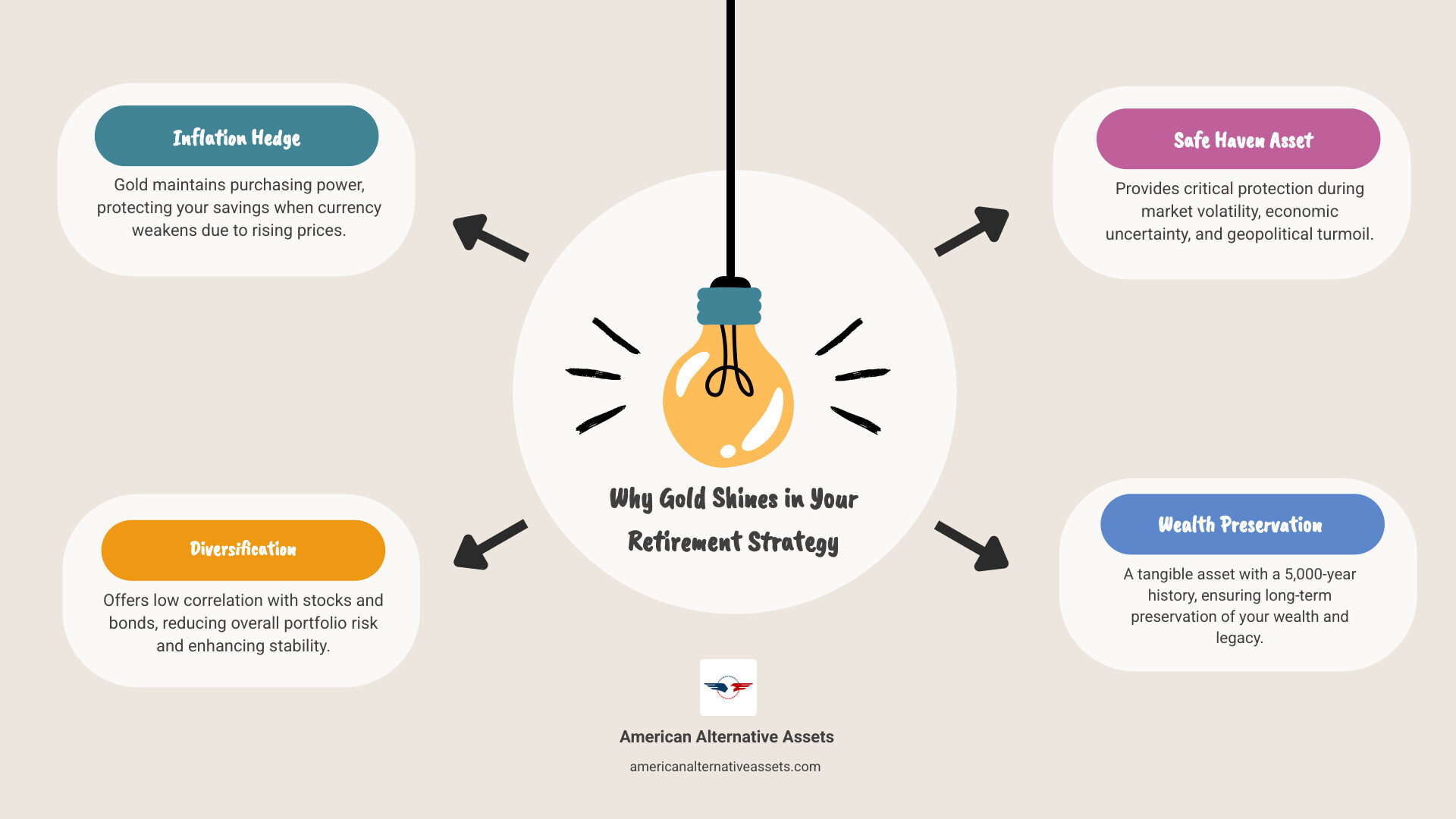
The Enduring Appeal: Why Gold Shines in a Retirement Strategy
Gold has been trusted for over 5,000 years—long before stocks, bonds, or retirement accounts ever existed. But nostalgia alone doesn’t make something a smart investment. The real question is: what does gold in a retirement portfolio actually do for you today, especially when you’re planning for decades of retirement ahead?
Let’s look at the practical reasons gold continues to earn its place in modern retirement strategies.
Hedge Against Inflation and Maintaining Purchasing Power
Inflation is the silent thief of retirement. It doesn’t announce itself with market crashes or dramatic headlines—it just quietly erodes what your money can buy, year after year.
Here’s where gold has historically shown its strength. When the dollar weakens and prices rise, gold tends to hold its value or even increase in price. The precious metal has appreciated over 750% since 2000, and even when you adjust for inflation, it’s still up 350% over that period. That’s not luck—it’s gold doing exactly what it’s supposed to do: maintaining purchasing power when paper currency struggles.
Think of it this way: if your retirement savings lose 20% of their buying power to inflation, but your gold allocation gains in value, you’ve just cushioned a significant blow to your lifestyle. You’re not getting rich from gold—you’re staying even, which in inflationary times is actually winning.

Safe-Haven Asset During Market Volatility and Geopolitical Risk
Retirement planning isn’t just about good times—it’s about preparing for the unpredictable. Market crashes, political upheaval, banking crises, international conflicts—these aren’t hypothetical scenarios. They happen, often when you least expect them.
Gold has earned its reputation as a safe-haven asset precisely because it behaves differently during these moments. When stocks are plummeting and investors are panicking, gold often moves in the opposite direction. It’s not perfectly counter-cyclical, but its tendency to hold value (or even appreciate) when traditional markets struggle makes it incredibly valuable for retirees who can’t afford to ride out long recoveries.
This is especially important as you near or enter retirement. A 30-year-old can wait out a five-year bear market. A 65-year-old living on their savings? Not so much. Gold provides protection during market volatility and geopolitical risk when you need stability most.
Portfolio Diversification and Low Correlation to Stocks and Bonds
Here’s a term you’ve probably heard: diversification. It sounds technical, but the concept is simple—don’t put all your eggs in one basket. The magic of gold isn’t just that it’s a different basket, but that it behaves independently from your other baskets.
Gold has a low correlation to stocks and bonds, meaning when one goes down, gold doesn’t automatically follow. Sometimes it goes up. Sometimes it stays flat. The point is, it doesn’t move in lockstep with your other investments. This independent behavior reduces your portfolio’s overall risk without necessarily reducing your returns.
Think of gold in a retirement portfolio as insurance. You pay for car insurance hoping you’ll never need it, but you sleep better knowing it’s there. Gold works similarly—it’s the asset that protects your other investments by zigging when they zag.
Tangible Asset and Wealth Preservation
There’s something reassuring about an asset that’s existed for millennia. Gold isn’t a company that can go bankrupt. It’s not a currency that a government can print more of. It’s not dependent on someone else’s promise or a complex financial system. It’s a tangible asset—real, physical, and fundamentally valuable.
This matters for wealth preservation. While gold’s primary use today is as a store of value, that’s exactly what makes it powerful for retirement. You’re not looking to double your money overnight with gold. You’re looking to preserve what you’ve spent decades building. Gold has outlasted empires, currencies, and countless financial systems. That track record speaks volumes about its role in protecting wealth across generations.
At American Alternative Assets, we’ve seen how adding physical precious metals to retirement portfolios provides clients with both practical diversification and genuine peace of mind. It’s not about fear—it’s about balance, preparation, and building a retirement strategy that can weather whatever comes next.
A Practical Guide to Owning Gold for Retirement
When you’re ready to add gold in a retirement portfolio, you’ll find several paths forward. For many investors, especially those planning for long-term wealth preservation, the Gold IRA stands out as a particularly smart choice. It combines the tangible security of physical gold with the tax advantages you’d expect from a traditional retirement account.
Gold IRAs (Individual Retirement Accounts for Physical Precious Metals)
A Gold IRA is a special type of self-directed IRA that lets you hold physical precious metals—gold, silver, platinum, and palladium—inside a tax-advantaged retirement account. Think of it as giving your retirement savings the same tax benefits as a traditional IRA or 401(k), but with the stability and diversification that precious metals provide.
The key difference? While most retirement accounts limit you to stocks, bonds, and mutual funds, a self-directed IRA opens the door to alternative assets. This flexibility is invaluable if you’re looking to diversify beyond conventional paper assets and add a layer of protection against market volatility.
Here’s what sets Gold IRAs apart as a retirement investment vehicle:
Ownership: You own specific, IRS-approved physical gold coins or bars—think American Gold Eagles, Canadian Gold Maple Leafs, or Gold American Buffaloes. These aren’t just numbers on a screen; they’re real metal held securely on your behalf by a third-party custodian in an IRS-approved depository. Important note: IRS rules require professional storage, so you can’t keep your Gold IRA assets at home.
Liquidity: While selling gold from your IRA isn’t quite as instant as clicking “sell” on a stock trade, the process is straightforward. You can sell your metals back to dealers or through your custodian when needed. Just keep in mind that dealers typically buy at slightly below market price—that’s how they stay in business and ensure their profit margin.
Costs: Gold IRAs involve several fees that traditional IRAs don’t. You’ll pay for initial setup, annual maintenance by your custodian, and separate storage fees from the depository. These costs are part of owning physical metals and should factor into your overall return expectations. Think of them as the price of having real, tangible assets protecting your retirement.
Security: Your gold is stored in highly secure, IRS-approved depositories with insurance coverage. This professional storage meets strict regulatory requirements and gives you peace of mind that your precious metals are protected.
The beauty of a Gold IRA is that it bridges two worlds: the time-tested security of physical gold and the modern convenience of a tax-advantaged retirement account. It’s a practical solution for investors who want the best of both approaches.