








Why a TSP Tax Exempt Rollover Could Be the Most Important Financial Move You Make
A tsp tax exempt rollover is one of the most overlooked, and most valuable, tools available to uniformed service members who earned pay in a combat zone. Get it wrong, and the IRS takes a cut of money that was never supposed to be taxed in the first place.
Here is a quick summary of what you need to know:
| Key Question | Quick Answer |
|---|---|
| What is a TSP tax exempt rollover? | Moving nontaxable combat zone contributions from your TSP to an IRA or eligible retirement plan while preserving their tax-free status |
| Who qualifies? | Uniformed service members who contributed tax-exempt combat zone pay to their TSP |
| Are earnings also tax-free? | No. Only the contributions are tax-exempt. Earnings on those contributions are taxable (unless in a qualified Roth distribution) |
| Can you roll it directly to a Roth IRA? | Yes, but with specific steps. The receiving plan must accept tax-exempt funds, or the amount is paid directly to you |
| What is the biggest risk? | Taking an indirect rollover incorrectly, missing the 60-day window, or having the receiving plan reject the tax-exempt balance |
The stakes are real. Distributions from TSP accounts with tax-exempt contributions are paid out proportionally, meaning your taxable and nontaxable amounts come out together. If the receiving plan cannot accept tax-exempt funds, that money gets sent directly to you, and the clock starts ticking on a 60-day window to protect it.
Many service members spend years building up nontaxable balances from combat deployments, only to lose the tax-free advantage at distribution because the rollover was not handled correctly. This guide walks you through exactly how to avoid that outcome.
I’m Shanon Davis, founder of American Alternative Assets, and after watching the 2008 financial crisis expose how fragile paper-based retirement systems can be, I’ve spent years helping Americans navigate complex retirement decisions, including the tsp tax exempt rollover, to protect wealth that took a lifetime to build. In the sections ahead, I’ll break down the rules, the process, and the strategies that matter most.
This article is for informational purposes only and does not constitute financial advice. Please consult your financial advisor before making investment decisions. Investing in precious metals involves risk. Past performance does not guarantee future results.
Understanding Tax-Exempt Contributions in the Thrift Savings Plan

When we talk about the Thrift Savings Plan (TSP), most people think of it as the government version of a 401(k). For many federal employees, that is exactly what it is. But for those in the uniformed services, the TSP has a unique feature that can feel like a financial superpower: tax-exempt contributions.
These are not your standard pre-tax or Roth contributions. These funds originate from pay earned while serving in a designated combat zone. Under the Internal Revenue Code Section 112, this pay is excluded from gross income. When you contribute that “untaxed” money into your TSP, it creates a nontaxable basis within your account.
It is vital to Learn about TSP Withdrawal Options early on, because how you take this money out determines whether it stays tax-free or gets tangled up in IRS red tape.
Who Can Make Tax-Exempt Contributions?
Only members of the uniformed services are eligible to make these specific contributions. If you served in a combat zone and received tax-exempt pay, you had the option to funnel that money into your TSP. Unlike civilian contributions which are limited by annual elective deferral limits, military members can often contribute much more in a year when combat zone pay is involved, up to the Section 415(c) limit.
This means a soldier, sailor, or airman could potentially leave a deployment with a significant “nontaxable” bucket sitting inside their traditional TSP balance. This money has never been taxed, and if you handle your tsp tax exempt rollover correctly, the principal will never be taxed again.
How the TSP Tracks Nontaxable Balances
You might wonder how the TSP keeps track of which dollar is which. They use a sophisticated accounting system that segregates your “nontaxable basis” from your “taxable balance.”
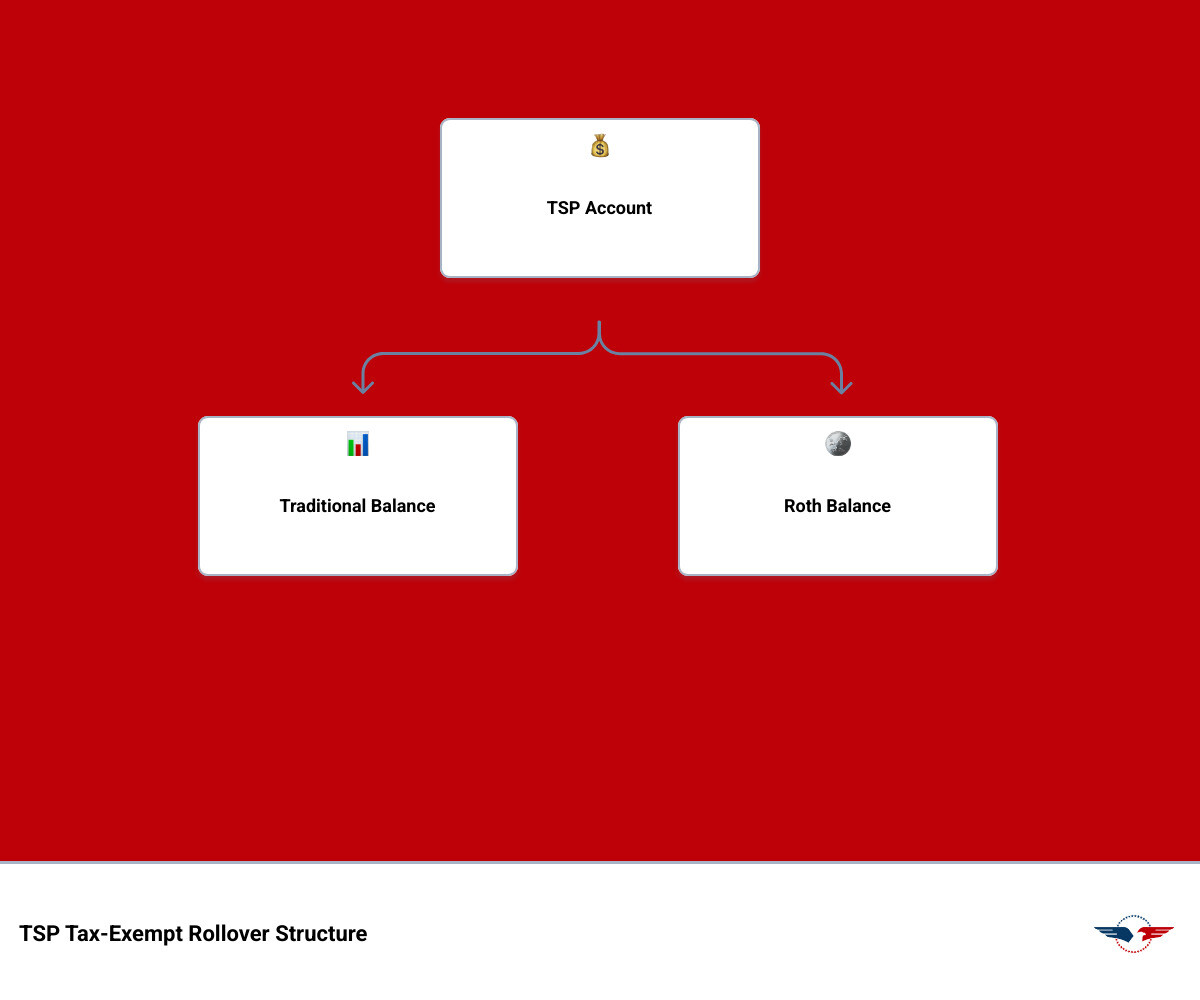
If you look at your TSP statement, you might see a traditional balance and a Roth balance. Within that traditional balance, the TSP tracks your tax-exempt contributions separately from your tax-deferred contributions (like your basic pay earned stateside). Even though they are all sitting in the “Traditional” bucket, the TSP knows exactly how much of that total represents combat zone pay. This tracking is essential because, upon distribution, the tax treatment of these two types of money is completely different.
The Proportional Rule: How the TSP Handles Mixed Distributions
This is where things get a bit tricky. You cannot simply tell the TSP, “Hey, just send me the tax-exempt stuff first.” The IRS follows what we call the “pro-rata” or proportional rule.
Every time you take money out of a TSP account that contains both taxable and nontaxable funds, the distribution must be made proportionally from both sources. For example, if 10 percent of your traditional TSP balance consists of tax-exempt combat zone contributions, then 10 percent of every withdrawal you take will be considered nontaxable. The other 90 percent will be taxed as ordinary income.
You can see how this works by looking at the IRS Rollover Chart, which outlines how different types of retirement funds interact.
Proportional Distribution Rules for Withdrawals
Imagine you have a $100,000 traditional TSP balance. Inside that balance, you have $10,000 in tax-exempt combat zone contributions and $90,000 in taxable contributions and earnings. If you decide to withdraw $10,000, you don’t get to pick the tax-exempt $10,000.
Instead, the TSP will send you $1,000 of nontaxable money (10 percent) and $9,000 of taxable money (90 percent). This proportional rule applies to almost all distributions, including partial withdrawals and even Roth in-plan conversions.
Taxation of Earnings on Tax-Exempt Pay
There is a common misconception that if the contribution was tax-exempt, the growth on that money is also tax-exempt. Unfortunately, that is not usually the case for traditional TSP accounts.
While your combat zone contributions are distributed tax-free, the earnings generated by those contributions are treated as tax-deferred. This means when you withdraw the earnings, they are taxed as ordinary income.
The only way to get tax-free earnings is if those tax-exempt contributions were placed into a Roth TSP and the distribution meets “qualified” status. A qualified Roth distribution requires the account to be at least five years old and the participant to be at least 59.5 years old, disabled, or deceased.
| Account Type | Contribution Tax Status | Earnings Tax Status |
|---|---|---|
| Traditional (Tax-Deferred) | Taxed upon withdrawal | Taxed upon withdrawal |
| Traditional (Tax-Exempt) | NEVER taxed | Taxed upon withdrawal |
| Roth TSP (Qualified) | Already taxed | NEVER taxed |
| Roth TSP (Non-Qualified) | Already taxed | Taxed upon withdrawal |
Executing a TSP Tax Exempt Rollover to an IRA
If you are separating from the service or retiring, you might want to move your money out of the TSP and into a private account, like a Precious Metals IRA. To do this without a tax headache, you must perform a tsp tax exempt rollover.
You have two main ways to do this: a direct rollover or an indirect rollover. We always prefer the direct method. In a direct rollover, the TSP sends the money directly to your new IRA custodian. If you do an indirect rollover, the TSP sends the check to you, and you have exactly 60 days to deposit it into a new retirement account. If you miss that window, the taxable portion becomes a giant tax bill, and you lose the tax-exempt status of your combat pay forever.
Step-by-Step Guide to a TSP Tax Exempt Rollover
- Open Your Receiving Account: Before you talk to the TSP, you need a place for the money to go. If you want to diversify into physical assets, you would open a self-directed IRA with a custodian that handles precious metals.
- Add the Institution to Your TSP Profile: Log into your TSP account and add the financial institution’s information. There is a mandatory seven-day waiting period after adding a new institution before you can initiate a transfer.
- Initiate the Request: Under “Withdrawals and Rollovers Out,” select the amount you wish to move.
- Check the Tax-Exempt Box: Ensure you are directing the TSP to include your nontaxable balance.
- Verify Withholding: In a direct rollover, federal withholding should be zero. If you see a 20 percent withholding, you are likely accidentally setting up an indirect rollover.
Common Pitfalls in a TSP Tax Exempt Rollover
The biggest trap is the mandatory 20 percent federal tax withholding that applies to the taxable portion of indirect rollovers. If you receive a check for $100,000, the TSP might only send you $80,000 and send $20,000 to the IRS. To complete a “full” rollover and avoid taxes, you would have to find $20,000 of your own cash to put into the new IRA within 60 days.
Another pitfall is “commingling.” If you roll your TSP funds into an existing IRA that you’ve been contributing to, it can be harder to move those funds back into an employer plan later. Keeping a “conduit IRA” or a clean rollover account is often a smarter move.
What to Do if a Receiving Plan Rejects Tax-Exempt Balances
Not all IRAs or employer plans are equipped to track a nontaxable basis. If your receiving plan tells the TSP they won’t accept tax-exempt funds, the TSP will simply cut you a check for that portion and pay it directly to you.
If this happens, don’t panic. You can still protect that money. Many participants choose to deposit that specific tax-exempt check into a Roth IRA. Since the money has already “paid its taxes” (by being exempt), moving it into a Roth account allows it to grow, and if you meet the Roth requirements, those future earnings could eventually become tax-free too.
Strategic Moves: Roth In-Plan Conversions and Physical Assets
Once you understand how the tsp tax exempt rollover works, you can start looking at more advanced strategies to protect your purchasing power. One option is a Roth in-plan conversion. This allows you to move money from your traditional TSP balance to your Roth TSP balance.
However, remember the proportional rule. You cannot choose to only convert the tax-exempt portion. If you convert $10,000 and your account is 10 percent tax-exempt, you will convert $1,000 of tax-exempt money and $9,000 of taxable money. You will owe income tax on that $9,000 in the year of the conversion.
How Conversions Affect Tax-Exempt Amounts
A Roth in-plan conversion is irreversible. Once you move that money to the Roth side, you cannot move it back. The minimum amount for a conversion is $500. The TSP will report this move on Form 1099-R, and it will be added to your taxable income for the year.
For many of our clients, the goal of a rollover isn’t just to change the tax status, but to change the asset status. While the TSP offers the G Fund and various index funds, these are all paper assets. They are subject to the whims of the stock market and the declining value of the dollar.
Protecting Your TSP Rollover with Physical Gold and Silver
At American Alternative Assets, we believe that true financial preparedness involves more than just picking the right tax bucket. It involves owning tangible, physical assets that have held value for thousands of years.
By executing a tsp tax exempt rollover into a self-directed Precious Metals IRA, you can move away from a 100 percent paper-based portfolio. Unlike stocks or mutual funds, physical gold and silver have intrinsic value and are not someone else’s liability.
In times of high inflation or market volatility, paper assets can lose significant value quickly. Physical precious metals are widely seen as a hedge against these risks. When you roll your TSP funds into a Precious Metals IRA, you get the same tax advantages of the IRA structure, but with the added security of physical bars and coins held in a secure depository.
Frequently Asked Questions about TSP Tax Exempt Rollovers
Can I roll over only the tax-exempt portion of my TSP?
No. Because of the pro-rata requirements, you generally cannot cherry-pick only the tax-exempt funds for a partial distribution. The distribution will be proportional to your total traditional balance. However, if you are doing a full withdrawal or rollover of your entire traditional balance, the TSP will separate the taxable and nontaxable portions for you, directing the taxable portion to one destination and the nontaxable portion to another (or to you) as requested.
Are earnings on combat zone contributions also tax-exempt?
In a traditional TSP, no. The contributions are tax-exempt, but the earnings are tax-deferred. You will pay ordinary income tax on the earnings when you withdraw them. If the contributions were in a Roth TSP, the earnings can become tax-exempt if the distribution is “qualified” (5-year rule + age 59.5).
How is a TSP tax exempt rollover reported to the IRS?
The TSP will issue Form 1099-R. This form will show the total distribution in Box 1 and the taxable amount in Box 2a. The difference between those two numbers represents your nontaxable basis (the tax-exempt combat pay). You must report this correctly on your tax return to ensure you aren’t taxed on money you already earned tax-free.
Conclusion
Preserving the wealth you earned while serving in a combat zone is about more than just following the rules. It is about taking control of your future. A tsp tax exempt rollover is a powerful way to ensure that the IRS doesn’t take a second bite out of your hard-earned savings.
At American Alternative Assets, we specialize in helping federal employees and service members transition from the limited options of the TSP to the robust protection of a physical Precious Metals IRA. Our white-glove, relationship-first service ensures that your rollover is handled with the transparency and ethical care you deserve.
Don’t leave your retirement to the mercy of paper markets and inflation. Take the first step toward real wealth protection today.
Secure your retirement with a Gold IRA
Disclaimers: This article is for informational purposes only and does not constitute financial advice. Please consult your financial advisor before making investment decisions. Investing in precious metals involves risk. Past performance does not guarantee future results.