








Why Direct Gold Ownership Is the Foundation of Real Wealth Protection
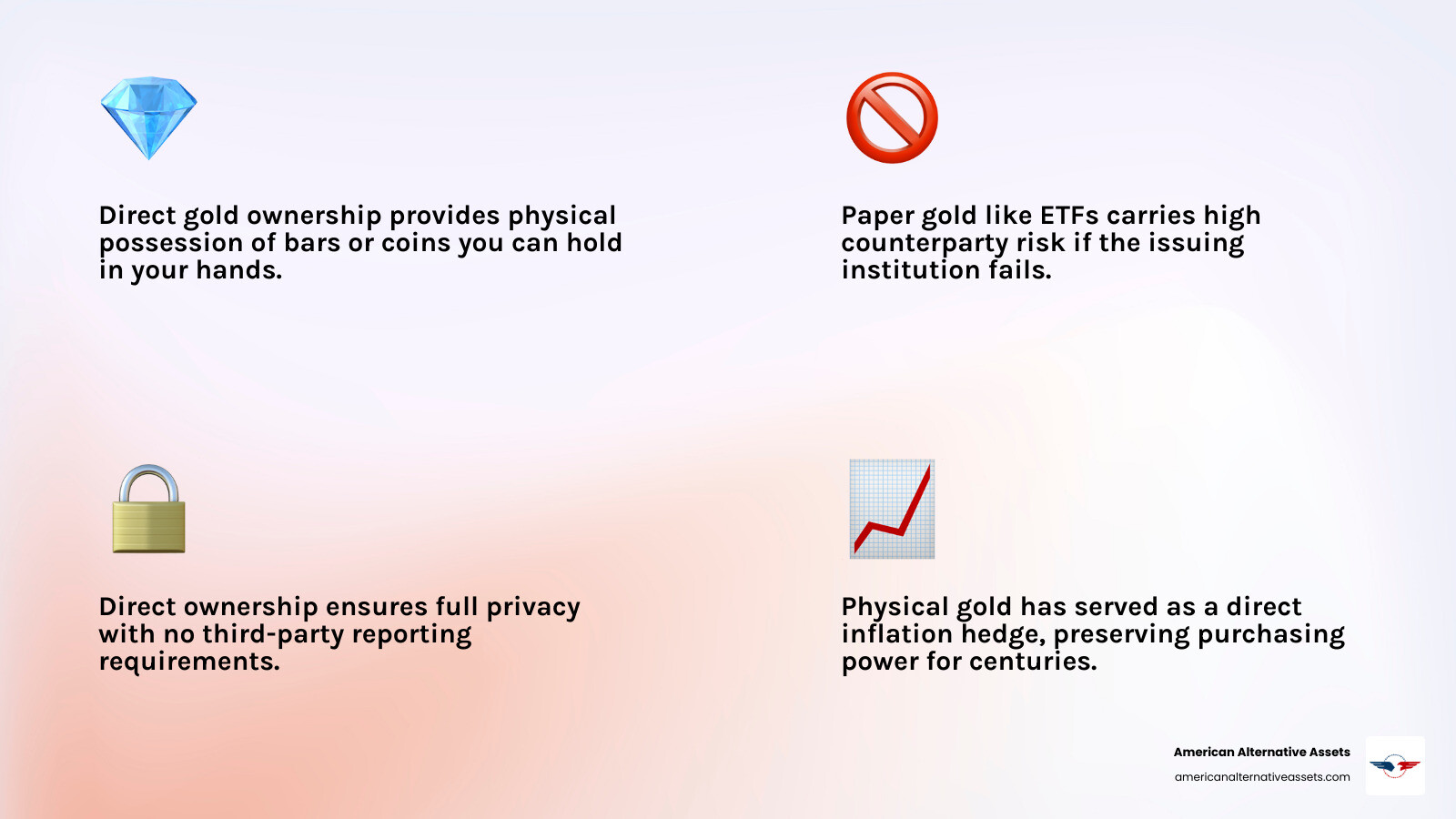
Direct gold ownership means holding physical gold, such as bars or coins, in your own name, with no middlemen, no paper contracts, and no reliance on another party’s promise to pay.
Here is a quick breakdown of what it means and why it matters:
| Feature | Direct Gold Ownership | Paper Gold (ETFs, Futures) |
|---|---|---|
| Physical possession | Yes | No |
| Counterparty risk | None | High |
| Private ownership | Yes | Partial or none |
| Inflation hedge | Direct | Indirect |
| Accessible in a crisis | Yes | Depends on market access |
If you hold a gold ETF or a futures contract, you own a financial claim, not gold itself. If the institution behind that claim fails, your “gold” may vanish with it. Real-world cases like the MF Global collapse showed exactly how that plays out: investors who held gold through intermediaries found themselves unable to access or verify their holdings.
Physical gold is different. It is tangible. You can see it, hold it, and store it. Its value does not depend on any bank, broker, or government staying solvent.
Small bars and coins alone have accounted for roughly two-thirds of annual gold investment demand over the past decade. That is not a coincidence. Investors around the world recognize that holding the real thing is fundamentally different from holding a paper promise.
I’m Shanon Davis, and my journey with direct gold ownership started long before my years in venture capital, when my grandfather placed a silver Morgan coin in my hand and said, “This is real money.” After watching the 2008 financial crisis expose just how fragile paper-based systems can be, I built American Alternative Assets to help everyday investors hold wealth that does not depend on anyone else’s promises.
This article is for informational purposes only and does not constitute financial advice. Please consult your financial advisor before making investment decisions. Investing in precious metals involves risk. Past performance does not guarantee future results.
What is Direct Gold Ownership and Why It Matters
When we talk about direct gold ownership, we are talking about the ultimate form of financial sovereignty. It is the difference between owning a house and having a piece of paper that says you might be allowed to sleep in a house if the bank says it is okay. In precious metals, direct ownership means you have the legal title to specific, physical bars or coins.
This matters because it removes “counterparty risk.” In simple terms, counterparty risk is the danger that the person or company on the other side of your investment will not be able to fulfill their end of the bargain. If you own physical gold, there is no “other side.” The gold is just there.
According to the Retail Gold Investment FAQs | World Gold Council, small bars and coins make up a massive portion of global gold demand. This is because physical gold provides a level of tangible security that digital numbers on a screen simply cannot match. It is private wealth that you control completely.
Direct Gold Ownership vs. Paper Assets
Many people think they “own gold” because they bought shares in a fund like the SPDR Gold Shares (GLD ETF). While these funds track the price of gold, they are not the same as owning the metal.
When you buy an ETF, you are buying a share in a trust. You do not have the right to ask for your gold to be delivered to your door unless you are an “Authorized Participant,” which usually means you are a massive institutional bank. For the average investor, paper gold is just another stock market product. It is subject to market volatility, systemic fragility, and the creditworthiness of the institutions managing the fund.
If the stock market has a “liquidity event” (a fancy way of saying everyone is panicking and selling everything at once), paper gold can drop in price just like everything else. Physical gold, however, remains a hard asset. It cannot be printed, and it cannot be deleted by a computer error.
The Benefits of Direct Gold Ownership
The biggest advantage we see for our clients is full control. When you own physical gold, you decide how it is stored and when it is sold. You are not waiting for a brokerage to open or a bank to approve a wire transfer.
Gold is also a legendary hedge against inflation and currency devaluation. Consider this: the US dollar has lost about 97% of its purchasing power since 1913. In that same time, the price of gold has climbed by more than 9,000%. While the dollar buys less and less every year, gold has historically maintained its value. It acts as financial insurance for your purchasing power.
Choosing the Right Physical Gold Products
Not all gold is created equal. If you are looking for direct gold ownership as an investment, you want to focus on “bullion.” Bullion is gold that is valued based on its weight and purity, rather than its “collectible” or artistic value.

Investment Bars vs. Bullion Coins
You generally have two choices: bars or coins.
- Investment Bars: These come in various sizes, from tiny 1 gram bars to massive 400 troy ounce “Good Delivery” bars. For most individual investors, bars in the 1 ounce to 10 ounce range are the most practical. They often have lower premiums over the “spot price” of gold because they are easier to manufacture than coins.
- Bullion Coins: These are minted by sovereign governments. Examples include the American Eagle or the Canadian Maple Leaf. These coins are legal tender, but their real value comes from their gold content. They are highly recognizable, which makes them very easy to sell later.
According to the Investing in Gold & Silver Bullion: A Complete Guide, bullion must be at least 99.5% pure to be considered investment grade.
IRA-Eligible Gold Standards
If you are looking to hold gold in a retirement account, the IRS has very specific rules. You cannot just put any gold coin into an IRA. To qualify, the gold must meet a fineness standard of .995 or higher.
The most popular IRA-eligible products include:
- American Eagle Gold Coins (the only exception to the .999 purity rule, as they are .9167 pure but specifically allowed by the IRS).
- Canadian Maple Leafs (.9999 pure).
- Australian Kangaroo/Lunar Series (.9999 pure).
- Standardized bullion bars from approved refiners like PAMP Suisse or Perth Mint.
Verifying Authenticity and Provenance
One of the biggest fears beginners have is buying “fake” gold. This is why we always recommend working with reputable dealers who source their metals directly from world-class mints.
To verify your gold, look for:
- Hallmarks: The stamp of the refiner, the weight, and the purity.
- Assay Cards: Many bars come in sealed plastic cards that act as a certificate of authenticity.
- Serial Numbers: Most investment-grade bars have a unique serial number etched into the metal.
Secure Storage and Verification Strategies
Once you have achieved direct gold ownership, the next question is: where do you put it? You have three main options, and each has its own set of pros and cons.
Professional Depositories
For most of our clients, especially those with a Precious Metals IRA, professional depositories are the gold standard. These are high-security facilities that do nothing but store precious metals. They are often located in “safe jurisdictions” like Delaware or Texas.
When you use a depository, you should opt for allocated storage. This means the specific bars you bought are held in your name. They are not “pooled” with other people’s gold. You get a certificate that lists your specific serial numbers. This ensures that if the depository ever went out of business, the gold is legally yours and cannot be used to pay the depository’s debts.
Best Practices for Physical Possession
If you are buying gold outside of an IRA, you might choose to keep it at home. This offers the ultimate accessibility, but it comes with risks. If you go this route, we suggest:
- Investing in a high-quality, heavy-duty safe that is bolted to the floor.
- Keeping your mouth shut. The best security is nobody knowing you have gold.
- Checking your homeowner’s insurance. Most standard policies have very low limits for precious metals, so you may need a special “rider” or separate policy.
Bank safe deposit boxes are another option, but keep in mind that banks are only open during certain hours, and your contents are generally not insured by the bank or the FDIC.
Managing Costs and Liquidity
There are costs involved in direct gold ownership, and it is important to be transparent about them.
- Premiums: This is the amount you pay over the “spot price” to cover the dealer’s costs and the minting of the gold.
- Storage Fees: If you use a professional vault, you will pay an annual fee for security and insurance.
- Spreads: This is the difference between the price you buy at and the price you can sell at.
The good news is that physical gold is incredibly liquid. Because gold is a global currency, there is always a buyer. Whether you are in Woodland Hills, California, or halfway across the world, people know what a gold bar is worth.
Building Your Portfolio with a Precious Metals IRA
At American Alternative Assets, we specialize in helping clients set up Precious Metals IRAs. This is a self-directed IRA that allows you to hold physical gold and silver instead of just stocks and bonds.
The Power of the Rollover
Most people don’t realize they can take a portion of their existing 401(k) or traditional IRA and roll it over into physical gold without any tax penalties. This allows you to diversify your retirement savings into a “safe haven” asset while keeping the tax-deferred status of your account.
In times of economic uncertainty, having a portion of your retirement in an asset that has no counterparty risk provides a level of stability that is hard to find elsewhere.
Steps to Start Your Direct Gold Ownership Journey
Starting your journey is simpler than most people think. We focus on a white-glove, relationship-first process:
- Custodian Selection: We help you choose a trusted IRA custodian who specializes in alternative assets.
- Account Funding: You fund the account via a contribution or a tax-free rollover from an existing retirement plan.
- Bullion Selection: You choose the specific IRA-eligible gold coins or bars you want to own.
- Secure Delivery: Your gold is shipped via insured transit directly to a secure, IRS-approved depository.
- Monitoring: You receive regular statements showing your holdings and their current market value.
Frequently Asked Questions about Direct Gold Ownership
Can I store my IRA-eligible gold at home?
This is a very common question, and the answer is a firm “No.” IRS regulations require that gold held within an IRA must be stored in the physical possession of a bank or an IRS-approved non-bank trustee. Some companies might try to sell you a “Home Storage IRA” or a “Checkbook IRA” that claims you can keep the gold in a safe under your bed. Be very careful. These structures are highly scrutinized by the IRS and can lead to massive taxes and penalties. For your protection, always use a professional depository for IRA assets.
How does direct gold ownership protect against inflation?
Gold is a finite resource. You cannot print more of it. When a government prints more currency, each individual dollar becomes worth less (inflation). Because there is a limited supply of gold, it takes more of those devalued dollars to buy the same amount of gold. This is why gold prices tend to go up when the dollar goes down. It acts as a “store of value” that has lasted for thousands of years.
Is physical gold more difficult to sell than paper gold?
This is a myth. While you can sell an ETF share with a click of a button, selling physical gold is also very fast. Reputable dealers, including us, often have buyback programs. You can also sell gold to coin shops or bullion dealers in almost any major city. Because gold is standardized by weight and purity, the valuation process is straightforward and quick.
Conclusion
At American Alternative Assets, we believe that direct gold ownership is the only way to truly “shine” when the economic weather gets cloudy. In a world of digital promises and complex financial derivatives, there is nothing quite like the security of holding a tangible asset.
Our mission is to provide you with the transparency and ethical guidance you need to protect your wealth. We don’t just sell gold, we build relationships based on trust and protection. Whether you are looking to hedge against inflation or secure your retirement with a Gold IRA, we are here to ensure your future is as solid as the metal you hold.
By choosing physical gold, you are taking a stand for financial preparedness and personal responsibility. You are moving away from the fragility of paper systems and toward the enduring strength of real, direct ownership.
Compliance and Disclaimers
This article is for informational purposes only and does not constitute financial advice. Please consult your financial advisor before making investment decisions.
Investing in precious metals involves risk. Past performance does not guarantee future results.