








Why Americans Are Turning to Physical Gold for Retirement Security
A gold IRA 401k rollover allows you to transfer funds from your employer-sponsored 401(k) into a self-directed IRA that holds physical precious metals like gold and silver coins or bars, giving you direct ownership of tangible assets that aren’t tied to stock market performance.
Quick Answer: Gold IRA 40ol(k) Rollover Basics
- What it is: Moving retirement funds from a 401(k) into a self-directed IRA that holds physical gold, silver, platinum, or palladium
- Why consider it: Diversify beyond paper assets, hedge against inflation, own tangible wealth
- Key difference: Gold IRAs hold physical metal you own directly, not stocks or ETFs
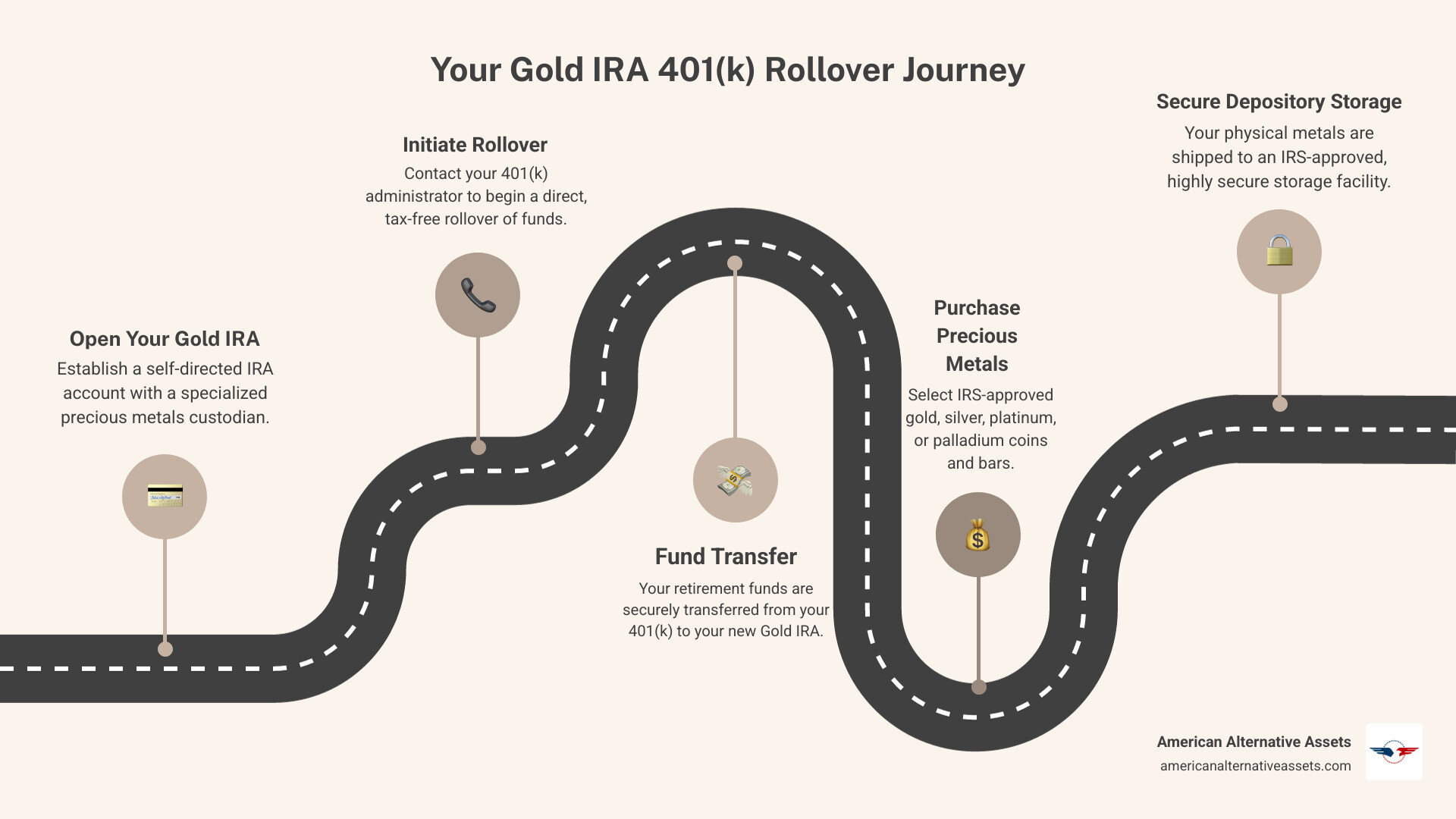
- How it works: Open a Gold IRA, initiate a direct rollover from your 401(k), purchase IRS-approved metals
- Tax treatment: Direct rollovers are typically tax-free and penalty-free when done correctly
- Storage requirement: Physical metals must be held in an IRS-approved depository, not at home
My grandfather handed me a silver Morgan coin when I was nine years old. He said, “This is real money.” I didn’t understand what he meant then, but decades later, after watching the 2008 crash wipe out families who thought their retirement was secure, it finally clicked. The system itself is fragile, and most Americans don’t realize they’re playing a rigged game until it’s too late.
That moment changed everything. I left venture capital to build American Alternative Assets, a company focused on teaching ordinary people how to hold value that doesn’t depend on anyone else’s promises. Over the years, I’ve guided thousands of Americans through the gold IRA 401k rollover process, helping them take control of their retirement with physical precious metals instead of paper promises.
This guide walks you through the entire process, from understanding what makes a Gold IRA different from a 401(k), to completing your rollover step-by-step, to navigating IRS rules with confidence. You’ll learn why physical gold offers protection that paper assets cannot, and how to avoid the common mistakes that trip up first-time investors.
Understanding the Key Differences: Gold IRA vs. 401(k)

When planning for retirement, understanding the tools at your disposal is crucial. A gold IRA 401k rollover involves two distinct types of retirement accounts: a Gold IRA and a 401(k). While both offer tax advantages for retirement savings, they differ significantly in what they allow you to hold and the level of control you have over your investments.
A Gold IRA holds physical, tangible precious metals you own directly, offering you more control through a self-directed account. A 401(k) is an employer-sponsored plan limited to paper assets like stocks and mutual funds, with investment choices selected by the plan administrator.
What is a Gold IRA?
A Gold IRA is a special type of Self-Directed Individual Retirement Account (SDIRA) that empowers investors to hold physical gold, silver, platinum, and palladium as part of their retirement portfolio. Unlike traditional IRAs that typically invest in paper assets like stocks, bonds, and mutual funds, a Gold IRA allows for tangible asset ownership. This means you own actual physical metal, not just shares in a fund that tracks its price. This direct ownership is a cornerstone of wealth preservation, offering a tangible layer of security to your portfolio. It allows for greater flexibility and control over your investments, letting you diversify beyond the confines of conventional financial markets.
How Does a 401(k) Compare?
A 401(k) is an employer-sponsored retirement plan where investment options are chosen and limited by the plan administrator, not by you. These accounts are restricted to paper assets like stocks, bonds, and mutual funds, leaving your retirement savings vulnerable to stock market volatility and inflation. Crucially, 401(k)s do not allow for direct investment in physical precious metals, preventing true diversification. Your investment choices are confined to a pre-selected menu of funds, giving you little to no direct control over the assets that are supposed to secure your future.
Types of Gold IRAs
Just like traditional IRAs, Gold IRAs come in different forms, each with unique tax implications:
- Traditional Gold IRA: Contributions to a Traditional Gold IRA may be tax-deductible, allowing your money to grow tax-deferred until you start taking withdrawals in retirement. This can lower your taxable income in the present.
- Roth Gold IRA: Contributions to a Roth Gold IRA are made with after-tax dollars, meaning they are not tax-deductible. However, qualified withdrawals in retirement are completely tax-free. As of 2025, Roth Gold IRAs are exempt from Required Minimum Distributions (RMDs) during the account holder’s lifetime, allowing investments to grow indefinitely.
- SEP Gold IRA: A Simplified Employee Pension (SEP) Gold IRA is designed for self-employed individuals and small business owners. It functions similarly to a Traditional IRA but allows for much higher contribution limits, making it an excellent option for those looking to build substantial retirement savings with precious metals.
The tax implications of each type depend on your current income, expected future income, and overall retirement strategy. Understanding these differences is key to making an informed decision about which Gold IRA best suits your needs. For a deeper dive into how these tax treatments work, you can Check out our Tax-Free vs Tax-Deferred Guide.
Why Consider a Rollover? The Strategic Advantages of a Gold IRA

Many Americans are seeking ways to fortify their retirement savings against the unpredictable tides of the global economy. A gold IRA 401k rollover offers a strategic pathway to achieve this. A Gold IRA allows you to hold a tangible asset that is not tied to the performance of corporations or government debt, acting as a potential hedge during economic turbulence.
Diversify Beyond Paper Assets
Diversification is a cornerstone of a robust investment strategy. By including physical precious metals in your retirement portfolio, you reduce your reliance on traditional paper assets like stocks and bonds, which can be highly correlated and vulnerable to market swings. Physical gold and silver offer a unique form of portfolio diversification because their value tends to move independently of, or even inversely to, stocks and bonds. Gold is widely viewed as a stable asset that can reduce overall portfolio risk, providing a counterbalance during periods when other asset classes may struggle. This can lead to a more balanced and resilient retirement portfolio.
A Hedge Against Economic Uncertainty
Gold has long been considered a safe-haven investment, particularly during times of economic uncertainty and market volatility. Its intrinsic value allows it to act as a powerful hedge against inflation and currency devaluation. When the purchasing power of fiat currencies declines, gold often retains or even increases its value, safeguarding your wealth. For example, historically, gold prices surged during the high-inflation period of the 1970s, offering a strong hedge against rising prices. Similarly, during the 2008 financial crisis, when major stock indices plummeted, gold not only held its value but significantly appreciated, showcasing its resilience. In an increasingly complex global landscape, physical precious metals can provide a critical layer of protection against geopolitical risks and economic instability.
The Pitfalls of “Paper Gold”
While some investors consider “paper gold” investments like Gold Exchange Traded Funds (ETFs), mining stocks, or mutual funds that track gold prices, it’s crucial to understand their fundamental difference from physical precious metals. These paper assets introduce counterparty risk, meaning your investment relies on the solvency and performance of the issuing institution, not on direct ownership of the metal itself.
Furthermore, paper assets can be restricted, margined, or even halted during market stress, leaving investors vulnerable when they need protection the most. Physical precious metals in a Gold IRA provide direct ownership and control, which paper-based alternatives cannot offer. You own the actual gold, silver, platinum, or palladium, held securely in your name. This tangible ownership eliminates counterparty risk and ensures that your retirement savings are anchored in real, universally valued assets, providing true diversification and peace of mind.
Your Step-by-Step Guide to a Gold IRA 401(k) Rollover
Starting on a gold IRA 401k rollover might seem like a complex endeavor, but we assure you, the process is straightforward when guided by a precious metals specialist. Our goal at American Alternative Assets is to make this transition seamless, ensuring your retirement funds are transferred smoothly and compliantly.
Step 1: Choose a Trusted Custodian and Open Your Account
The first and most critical step is to select a reputable Self-Directed IRA custodian that specializes in precious metals. Traditional brokerage firms typically do not offer Gold IRAs because they involve holding physical assets. You need a custodian experienced in handling alternative assets, one that can ensure your account adheres to IRS regulations.
At American Alternative Assets, we pride ourselves on providing white-glove, relationship-first service. We guide you through the entire application process, helping you set up your new Gold IRA account. Our expertise ensures that your account is established correctly, setting a strong foundation for your precious metals investments. This relationship-first approach, built on trust, transparency, and ethical practices, ensures real privacy and protection for your wealth.
Step 2: Initiate the Rollover from Your 401(k)
Once your Gold IRA account is established, the next step is to transfer funds from your existing 401(k). There are two primary methods for this:
- Direct Rollover: This is the most common and recommended method. The funds are transferred directly from your 401(k) plan to your new Gold IRA without you ever taking possession of the money. Since the funds never come into your hands, this type of rollover is not subject to taxes or penalties, making it the most efficient and secure option. You simply contact your 401(k) plan administrator and instruct them to send the funds directly to your new Gold IRA custodian.
- Indirect Rollover: In an indirect rollover, the funds are first distributed to you, and then you are responsible for depositing them into your SDIRA within 60 days. This method comes with a crucial caveat: your 401(k) administrator is typically required to withhold 20% of the distribution for federal taxes. To avoid taxes and penalties, you must deposit the full amount of your original distribution (including the 20% withheld) into your new Gold IRA within the 60-day window. If you fail to deposit the full amount, the withheld portion will be considered a taxable distribution and may incur a 10% early withdrawal penalty if you are under 59½. Due to these complexities and potential pitfalls, we strongly recommend a direct rollover.
We will assist you in contacting your 401(k) plan administrator and providing them with all the necessary information and instructions for a smooth transfer of funds to your new Gold IRA.
Step 3: Fund Your Account and Purchase Precious Metals
Once the funds from your 401(k) have been successfully transferred to your new Gold IRA, you are ready to purchase your precious metals. This is where you exercise direct control over your investment choices. You will select the IRS-approved precious metals you wish to hold in your IRA. This typically includes specific types of gold coins and gold bars, as well as silver, platinum, and palladium products that meet stringent purity standards.
We will work with you to place the order with a reputable precious metals dealer. Our guidance ensures that you select only IRS-approved metals, avoiding any products that might be considered collectibles and thus ineligible for an IRA. Once purchased, these metals are then shipped directly to an IRS-approved depository for secure storage, completing your gold IRA 401k rollover.
Common Mistakes to Avoid During Your Gold IRA 401(k) Rollover
Navigating a rollover successfully means being aware of potential missteps. Here are some common mistakes we help our clients avoid:
- Missing the 60-day deadline for an indirect rollover: As mentioned, failing to re-deposit funds within 60 days can lead to significant taxes and penalties.
- Choosing non-approved or collectible coins: Not all precious metal products are eligible for an IRA. Investing in unapproved items can result in your IRA being disqualified and treated as a taxable distribution.
- Attempting home storage: The IRS strictly prohibits holding IRA-owned physical precious metals at home. This will be considered a taxable distribution and incur penalties.
- Not seeking guidance from a specialist: The rules surrounding IRAs and precious metals can be complex. Working with an experienced partner like American Alternative Assets ensures you steer the process compliantly and efficiently.
Navigating the Rules: IRS Regulations for Your Gold IRA
When investing in a gold IRA 401k rollover, understanding and adhering to Internal Revenue Service (IRS) regulations is paramount. The IRS has specific, clear guidelines for holding precious metals in an IRA, which are easy to follow with the right partner. Our expertise ensures that your precious metals IRA remains compliant, safeguarding your retirement savings.
IRS-Approved Precious Metals
The IRS has strict purity standards for precious metals held within an IRA. Only certain types of gold, silver, platinum, and palladium coins and bars are eligible.
- Gold Purity: Gold must be at least 99.5% pure (.995 fineness).
- Silver Purity: Silver must be at least 99.9% pure (.999 fineness).
- Platinum and Palladium Purity: Both must be at least 99.95% pure (.9995 fineness).
There’s a notable exception to the gold purity rule: the American Gold Eagle coin, despite its 91.67% purity, is approved due to its status as U.S. legal tender.
Here is a list of common IRS-approved gold and silver coins that our clients often choose:
- Gold: American Gold Eagle, American Gold Buffalo, Canadian Gold Maple Leaf, Austrian Gold Philharmonic, Australian Gold Kangaroo.
- Silver: American Silver Eagle, Canadian Silver Maple Leaf, Austrian Silver Philharmonic, Australian Silver Kangaroo.
It’s crucial to avoid “collectibles,” which include rare coins, numismatic coins, and any items not meeting the strict purity standards or recognized by the IRS as investment-grade bullion. Investing in such items can lead to your IRA being disqualified.
Secure Storage Requirements
One of the most critical IRS rules for a Gold IRA is the secure storage of your physical precious metals. You cannot store your IRA-owned gold, silver, platinum, or palladium at home. The IRS prohibits personal possession of IRA metals, which is treated as a taxable distribution, potentially incurring taxes and a 10% penalty if you are under 59½.
Your precious metals must be held in an IRS-approved depository. These are highly secure, insured facilities designed specifically for the storage of precious metals. When setting up your Gold IRA, you will typically choose between two types of storage:
- Allocated Storage: Your metals are kept in a specific vault or container, clearly identified as yours, but they may be commingled with other investors’ metals of the same type and fineness.
- Segregated Storage: Your metals are stored in a separate, identifiable vault or container, distinct from all other assets in the depository. This ensures that the exact coins or bars you purchased are the ones you will receive upon distribution.
We work with a network of trusted, IRS-approved depositories to ensure your precious metals are stored safely and compliantly, offering you peace of mind. Our team, based out of Woodland Hills, CA, is well-versed in these regulations and can help you steer the best storage options for your needs.
Understanding Contribution and Distribution Rules for a Gold IRA 401(k)
The contribution and distribution rules for a Gold IRA generally mirror those of traditional IRAs, with a few nuances.
- Annual Contribution Limits: These limits apply to direct contributions you make to your Gold IRA. For 2025, you can contribute up to $7,000 per year, or $8,000 if you are age 50 or older. These limits apply across all IRAs you own, meaning if you have multiple IRAs (e.g., a Traditional and a Roth), your total contributions cannot exceed these amounts. Rollover contributions from a 401(k) to a Gold IRA are not subject to these annual limits. You can always Check IRS.gov for the latest contribution limits.
- Required Minimum Distributions (RMDs): For Traditional Gold IRAs, you must begin taking RMDs once you reach age 73. This is the minimum amount you must withdraw each year from your retirement account. You can take your RMDs in cash (by selling a portion of your metals) or, in some cases, take an “in-kind” distribution of the physical metals themselves. Roth Gold IRAs, as mentioned, are exempt from RMDs during the account holder’s lifetime.
- Early Withdrawal Rules: If you take distributions from your Gold IRA before age 59½, the withdrawals are generally subject to income tax and may incur a 10% early withdrawal penalty, unless an exception applies. It’s crucial to understand these rules to avoid unexpected tax liabilities.
We are here to help you understand how these rules apply to your specific situation, ensuring you make informed decisions for your retirement.
Frequently Asked Questions about Gold IRA Rollovers
Can I roll over a 401(k) from my current employer?
Yes, in many cases, you can. This is known as an “in-service distribution” or “in-service rollover.” However, eligibility depends on your age and your specific 401(k) plan rules. Many plans allow in-service rollovers once you reach age 59½, regardless of whether you’re still employed. Some plans may also permit rollovers of after-tax contributions even if you are younger. You must check with your 401(k) plan administrator to confirm your eligibility for a rollover while still employed, as plan rules can vary significantly. If you are separated from employment, rolling over your old 401(k) is almost always an option.
How long does the rollover process take?
The timeline for a gold IRA 401k rollover can vary, but generally, the process typically takes anywhere from 1 to 3 weeks. Direct rollovers are often faster, as funds move directly between custodians without additional steps. The overall duration depends on several factors:
- Custodial processing time: How quickly your new Gold IRA custodian can set up your account and process the incoming funds.
- Plan administrator response time: How promptly your former (or current) 401(k) plan administrator processes your rollover request. Some administrators can be slower than others.
- Fund transfer method: Electronic transfers are usually quicker than checks.
We at American Alternative Assets work diligently to expedite the process, coordinating closely with all parties to ensure a smooth and efficient transfer of your retirement funds.
Can I have both a 401(k) and a Gold IRA?
Yes, you can have both a 401(k) and a Gold IRA. Many people choose to roll over a portion of their 401(k) into a Gold IRA to protect that wealth with physical precious metals. This strategy allows you to secure part of your retirement savings in tangible assets that are not tied to the performance of the stock market. By holding a Gold IRA alongside a 401(k), you can hedge against the market volatility and inflation that can put your paper-based 401(k) assets at risk, creating a more resilient retirement plan anchored by the stability of physical gold and silver.
Take Control of Your Retirement with a Gold IRA
Transferring a portion of your 401(k) to a Gold IRA is a strategic decision to diversify your portfolio with a tangible asset, giving you more control over your financial future. In a world of economic uncertainty, having physical precious metals in your retirement account offers a unique layer of protection and peace of mind. We believe in empowering our clients to make informed choices that secure their wealth for generations. With a partner like American Alternative Assets, you can steer the process with confidence, ensuring your retirement is built on a foundation of trust and transparency.
Learn more about securing your future with a Precious Metals IRA.
This article is for informational purposes only and does not constitute financial advice. Please consult your financial advisor before making investment decisions.
Investing in precious metals involves risk. Past performance does not guarantee future results.