








The Truth About Gold IRA Home Storage (And What the IRS Actually Requires)
Gold IRA home storage is not permitted under IRS rules. Here is what you need to know at a glance:
- Home storage of IRA gold is prohibited. The IRS requires all precious metals held in an IRA to be stored at an approved third-party depository.
- Personal possession = taxable distribution. If you take physical control of your IRA metals, the IRS treats it as a withdrawal, triggering income taxes and potentially a 10% early withdrawal penalty.
- The “LLC loophole” does not work. Schemes that use an IRA-owned LLC to store gold at home have been rejected by the IRS and the U.S. Tax Court.
- Compliant storage means using an IRS-approved depository, managed by a qualified custodian, such as a bank or IRS-approved non-bank trustee.
The stakes are real. A Rhode Island couple, Andrew and Donna McNulty, learned this the hard way when a U.S. Tax Court ruled that storing IRA gold at home, even through a structured LLC arrangement, counted as a taxable distribution. The result: more than $270,000 in taxes and over $50,000 in penalties on roughly $730,000 in IRA assets.
If you are considering a precious metals IRA, understanding where your gold can and cannot be stored is one of the most important decisions you will make.
I’m Shanon Davis, founder of American Alternative Assets, and my background in venture capital and wealth preservation has given me a front-row seat to how gold IRA home storage schemes can quietly destroy retirement savings that took decades to build. That experience is exactly why I built this guide, so you can protect what you’ve worked for with clear, honest information.
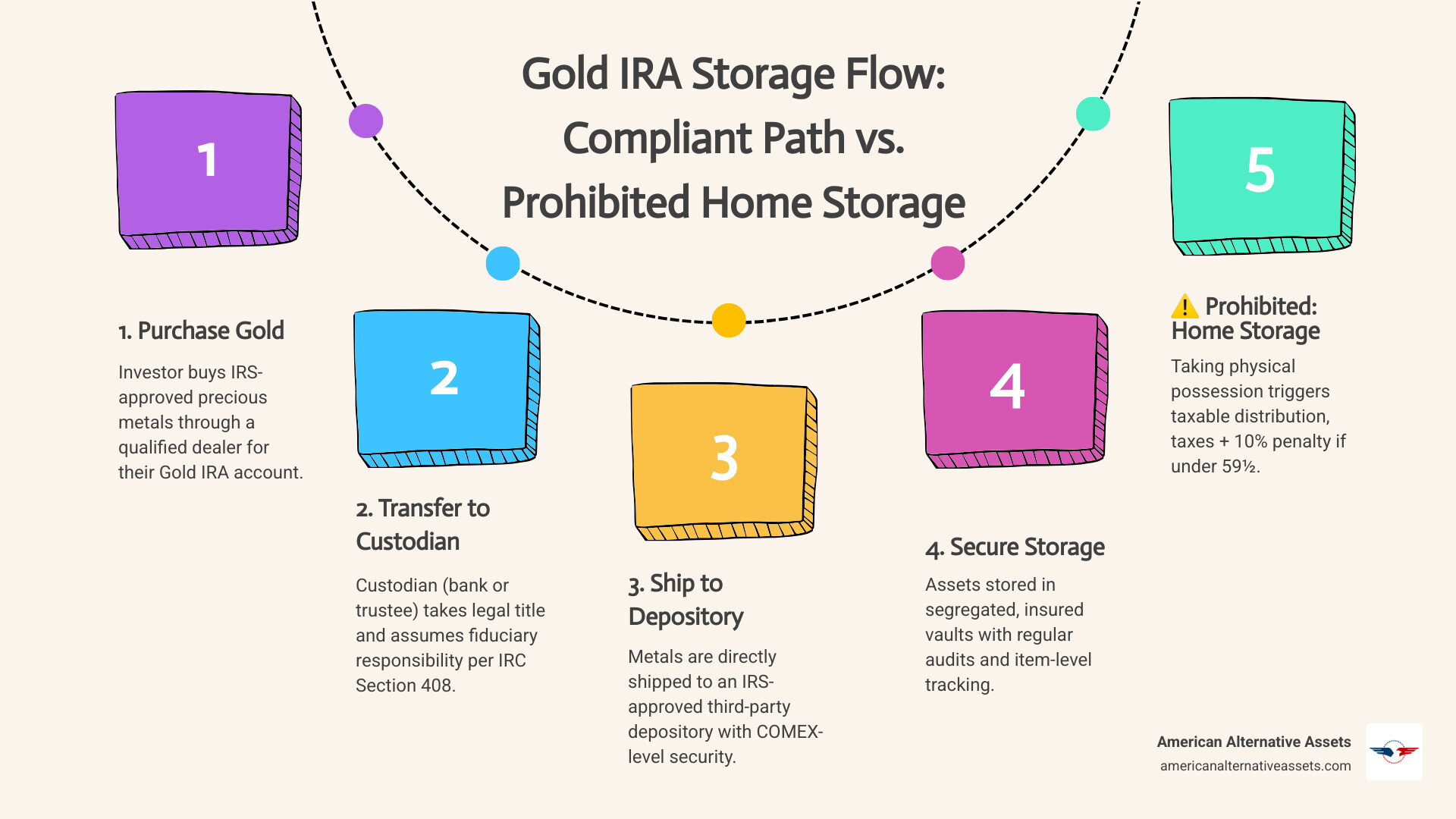
Understanding IRS Rules for Gold IRA Home Storage

When we talk about retirement accounts, we are talking about a partnership with the government. In exchange for tax advantages, we agree to follow specific rules. One of the most rigid rules involves the physical custody of assets. According to Internal Revenue Code (IRC) Section 408, the assets of an IRA must be held by a trustee or a custodian. This is not just a suggestion, it is a legal requirement to ensure that the assets are used for retirement and not for personal use before the proper time.
The IRS is very clear on this point. Physical gold held inside a retirement account cannot be kept in your kitchen drawer or a floor safe. Instead, it must be held in the physical possession of a bank or an IRS approved non bank trustee. This rule exists to create a clear line between your personal belongings and your tax advantaged retirement savings.
When you invest through a Precious Metals IRA, the custodian is responsible for the administrative side of things, while the depository handles the heavy lifting of security. This separation of duties is a hallmark of a compliant system. For more details on these requirements, you can review the Gold IRA storage rules: IRS requirements for storing precious metals.
At American Alternative Assets, we believe that physical ownership is the ultimate form of wealth protection. Unlike paper assets like gold ETFs or mining stocks, which are subject to counterparty risk and market manipulation, physical gold is a tangible asset that has maintained value for thousands of years. However, to keep that gold within the protective wrapper of an IRA, we must respect the storage mandates. You can find More info about Gold IRA regulations on our website to help you navigate these waters.
The Truth About Gold IRA Home Storage and LLC Structures
In recent years, a concept known as the “Checkbook IRA” or “Home Storage Gold IRA” has gained popularity. The pitch is often enticing. Promoters suggest that you can set up a Limited Liability Company (LLC) owned by your IRA, appoint yourself as the manager, and then use the LLC’s funds to buy gold that you store at home. They argue that because the LLC technically “owns” the gold, and you are just the manager, you aren’t in personal possession.
The IRS and the Tax Court disagree. They view this as “constructive possession.” If you have the keys to the safe where the IRA gold is kept, you have control over that asset. This violates the requirement that a qualified, independent trustee must maintain custody. The IRS focuses on actual control rather than just the paperwork.
Many of these schemes are marketed using “slick interpretations” of the law that do not hold up under audit. When an investor acts as their own trustee without meeting the incredibly high bar for IRS approval, they risk their entire retirement nest egg. For a deeper dive into these rules, see Gold IRA Tax Rules And Regulations: Key Things To Know.
Why Personal Possession is Prohibited
The Taxpayer Relief Act of 1997 expanded the types of precious metals allowed in IRAs, but it did not remove the custody requirements. The government insists on independent oversight for a simple reason. If you have the gold at home, there is nothing stopping you from selling a coin to pay for a vacation or using it as collateral for a personal loan.
By requiring a qualified custodian, the IRS ensures that every transaction is documented, every ounce is accounted for, and no “self dealing” occurs. This oversight is what maintains the tax deferred status of your account. We provide a comprehensive guide on Precious Metals IRA Custodians to explain how these professionals keep your account in good standing.
Risks and Penalties: Lessons from the McNulty Case
The case of Andrew and Donna McNulty is the most famous example of what happens when gold IRA home storage goes wrong. The couple used an LLC structure to purchase gold and silver coins with their IRA funds and then stored those coins in a safe at their home. They believed they were following the law, but the IRS viewed it differently.
The U.S. Tax Court ruled that because Donna McNulty had “unfettered control” over the coins, the purchase was actually a taxable distribution. This meant the entire value of the gold was added to their income for that year. Because they were under the age of 59 and a half, they also faced a 10% early withdrawal penalty.
The financial fallout was devastating:
- They owed approximately $270,000 in federal income taxes.
- They were hit with over $50,000 in additional penalties.
- Their total tax exposure reached nearly 40% of their IRA’s value.
This case set a definitive legal precedent. It proved that even with an LLC, storing IRA metals at home is a “prohibited transaction.” At American Alternative Assets, our goal is to help you avoid these pitfalls through Understanding Your Gold Storage Options clearly and accurately.
Comparing Costs of Gold IRA Home Storage Alternatives
Some investors are tempted by home storage because they want to avoid annual storage and custodian fees. However, when you compare the modest cost of professional storage to the massive penalties of an IRS audit, the choice becomes clear.
| Feature | Professional Depository | “Home Storage” IRA |
|---|---|---|
| IRS Compliance | Fully Compliant | High Risk of Disqualification |
| Security | Armed guards, 24/7 monitoring | Residential locks/safes |
| Insurance | Full “All-Risk” Coverage | Limited Homeowner’s Policy |
| Tax Status | Tax-Deferred or Tax-Free | Immediate Taxation if Audited |
| Audit Risk | Low | Very High |
| Potential Penalty | None | 10% Penalty + Full Income Tax |
Attempting to save on storage fees is like trying to save money on a parachute by buying a cheaper, uncertified version. The risk of the entire “retirement vessel” failing is simply too high.
Secure Alternatives: IRS Approved Depositories and Custodians
If you cannot store your gold at home, where should it go? The answer is an IRS approved depository. These are high security facilities designed specifically to protect precious metals. They are not just “warehouses,” they are fortresses.
Facilities like the Delaware Depository or Brink’s Global Services are industry leaders. These locations offer COMEX approved storage, meaning they meet the highest standards for security and integrity in the world. They use biometric scanners, motion sensors, and round the clock armed security to ensure your wealth is protected. You can learn more about Delaware Depository details on our site.
These facilities provide the peace of mind that comes with knowing your physical gold is safe from theft, fire, and natural disasters, all while remaining fully compliant with the law.
Segregated vs. Non-Segregated Storage
When you choose a depository, you generally have two choices for how your gold is kept:
- Segregated Storage: Your specific coins and bars are kept in a separate, individual locker or vault space. When you take a distribution, you get back the exact same items you bought. This is often preferred by investors who buy specific minted coins.
- Non-Segregated (Commingled) Storage: Your metals are stored with other investors’ metals of the same type and purity. You own a specific quantity of that metal. For example, if you own ten 1 ounce Gold bars, you are guaranteed ten 1 ounce Gold bars of the same refiner and purity upon distribution.
Both options are fully insured and audited. The choice usually comes down to personal preference and how much you value having “your” specific coins. For a deeper look, see What are Depository Accounts and How Do They Work?.
Insurance and Auditing Protocols
One of the biggest advantages of professional storage over a home safe is insurance. Most homeowner insurance policies cap coverage for precious metals at a very low amount, often between $1,000 and $2,500. If you have $100,000 in gold at home and it is stolen, your insurance will likely leave you with a massive loss.
Approved depositories carry “all risk” insurance policies, often through prestigious insurers like Lloyd’s of London. This covers the full replacement value of your metals against theft, damage, or loss. Furthermore, these facilities undergo regular third party audits. Independent accountants physically count the inventory to ensure that every ounce reported on your statement is actually in the vault. We even explain the process of Visiting Your Precious Metals at a Bullion Depository if you ever wish to see the facility for yourself.
How to Vet a Provider for Gold IRA Home Storage Compliance
Choosing the right partner is essential. If a company tells you that gold ira home storage is easy, legal, and risk free, that is a major red flag. A reputable provider will always prioritize your compliance over making a quick sale.
You should look for transparency in their business practices. Do they provide a clear fee schedule? Do they have a straightforward buyback policy? Are they willing to explain the IRS rules in detail? We provide an IRA Precious Metals Custodians Complete Guide to help you separate the experts from the promoters.
At American Alternative Assets, we pride ourselves on our white glove service. We don’t just sell you gold, we build a relationship built on trust and ethical practices. We want to ensure your wealth is truly protected, which means keeping it out of the crosshairs of the IRS.
Questions to Ask Your Gold IRA Provider
Before you sign any paperwork, we recommend asking the following questions:
- Which IRS approved depositories do you partner with?
- Can I see the insurance certificate for the storage facility?
- How often are the metals audited by an independent third party?
- What is the process and cost for liquidating my metals or taking an in-kind distribution?
- Do you offer segregated storage options?
A trustworthy provider will have no trouble answering these questions. You can find more guidance in our Gold IRA Guide.
Frequently Asked Questions about Gold IRA Storage
Can I store non-IRA personal gold at home?
Yes, absolutely. If you buy gold with your own after tax cash, you can store it wherever you like. Many of our clients choose to keep a portion of their physical gold in a high quality home safe for immediate access. However, you are responsible for the security and insurance of that gold. Given that homeowner policies have low caps, we always suggest looking into specialized private insurance for home stored metals.
What are the purity requirements for IRA metals?
The IRS has strict fineness standards. Gold must be at least 99.5% pure (.995 fineness). Silver must be 99.9% pure, and platinum/palladium must be 99.95% pure. There is one notable exception: the American Gold Eagle coin. Even though it is 22 karat (91.67% gold), it is specifically allowed by law for IRA investment. Items like 14k jewelry or most “collectible” coins do not qualify.
Can I take physical delivery of my gold later?
Yes, you can. When you reach retirement age (or even before, if you are willing to pay the taxes), you can take what is called an “in-kind distribution.” This means instead of selling the gold for cash, your custodian arranges for the physical bars or coins to be shipped from the depository directly to your home. At that point, the gold is yours to store however you wish, as it is no longer inside the IRA.
Conclusion
The dream of gold IRA home storage is often a nightmare in disguise. While the idea of holding your retirement gold in your own hands is appealing, the legal and financial risks far outweigh the benefits. The IRS rules are clear, and the penalties for breaking them can be life changing.
By choosing a physical Gold IRA with American Alternative Assets, you get the best of both worlds. You get the security and inflation hedging power of physical gold, and you get the peace of mind that comes with professional, IRS compliant storage. We are here to provide the white glove service and ethical guidance you need to protect your future.
Don’t let misleading marketing put your savings at risk. Secure your retirement with Delaware Depository storage and join the thousands of Americans who are taking personal responsibility for their wealth preservation through physical precious metals.
This article is for informational purposes only and does not constitute financial advice. Please consult your financial advisor before making investment decisions. Investing in precious metals involves risk. Past performance does not guarantee future results.