Best way to invest in gold stocks: Smart Strategies 2025
Why Gold Stocks Matter for Your Financial Security
The
best way to invest in gold stocks depends on your goals, with most investors choosing one of three main approaches:
- Gold-Focused Investment Vehicles (ETFs/Mutual Funds) – Best for beginners seeking diversification.
- Major Gold Mining Companies – Suitable for direct exposure to established producers.
- Gold Streaming and Royalty Companies – Ideal for gold exposure with lower operational risk.
With gold prices surging, many investors turn to physical bullion. However,
gold stocks offer something physical gold cannot: the ability to profit from both rising gold prices
and company growth. When a mining company improves efficiency or finds new deposits, its stock can climb even if gold prices are flat. This leverage means gold stocks often outperform bullion during rallies, but they also carry business and geopolitical risks.
The investment landscape has evolved, with Gold ETFs growing to $286 billion in assets since 2004. Unlike physical gold, which generates no cash flow, gold stocks can pay dividends and multiply returns. However, they also face operational challenges that don’t affect a gold bar in a vault.
This guide walks you through practical strategies for investing in gold stocks, from evaluating individual companies to selecting the right funds for your portfolio.
Why Add Gold Stocks to Your Investment Portfolio?
Gold stocks can be a thoughtful addition to a well-rounded investment strategy, offering protection and growth potential. The case for gold stocks rests on three pillars: they act as a
safe-haven during economic turbulence, help
protect against inflation, and offer
diversification that physical gold alone can’t match.
Research by the Federal Reserve Bank of Chicago confirms that investors regard gold as protective against “bad economic times.” When markets are volatile, gold has historically held its ground. But gold stocks offer an additional advantage: a “leverage effect.” As
owners of a business—such as a gold miner—can profit not only from the rising price of gold but also from the business itself, you capture both commodity price movement and company growth. This is the
best way to invest in gold stocks for growth potential.

The Leverage Advantage of Gold Mining Stocks
Leverage works because mining production costs are relatively fixed. If a company’s cost to mine an ounce of gold is $1,300, a price jump from $1,500 to $2,000 per ounce more than doubles their profit margin (from $200 to $700). This profit expansion creates a multiplier effect on earnings, often causing stock prices to outperform the metal itself during bull markets.
However, leverage is a double-edged sword. Falling gold prices can squeeze margins, and mining stocks face operational risks like equipment failures, labor disputes, and management decisions. You’re betting on the company’s efficiency as much as on the gold price.
Gold Stocks as a Hedge in Volatile Markets
Gold has a
low correlation to traditional stocks and bonds, meaning it often moves independently of other investments. This is especially valuable during periods of
political uncertainty and in
low-interest-rate environments. The
Federal Reserve Bank of Chicago research shows gold performs well when interest rates are low and uncertainty is high, as investors seek alternatives to low-paying bonds and risky stocks.
This dynamic is currently in play.
Wells Fargo Investment Institute points to ongoing gold purchases by global central banks and heightened geopolitical strife to support demand growth for precious metals. This central bank demand creates a steady floor for the metal. During
market turbulence, this safe-haven quality provides stability. While other assets may fall, your gold investments could hold steady or climb, acting as a form of financial insurance for your portfolio.
The Two Primary Types of Gold Stock Investments
When exploring the
best way to invest in gold stocks, you’ll find two main paths: buying shares in individual companies or investing in funds that hold baskets of these companies. Each approach offers a different risk and reward profile.

Gold Mining Companies: Direct Exposure to Production
Investing in gold mining companies means buying a piece of a business that explores for, develops, and operates mines. Your investment is tied not just to gold prices, but also to the company’s operational success.
- Major miners like Newmont Corp. (NEM) and Barrick Gold Corp. (GOLD) are large, established operators with multiple mines and substantial reserves. They offer more stability but may have less explosive growth potential.
- Junior miners are smaller, speculative companies focused on exploration. They carry higher risk, as many projects fail, but a successful findy can lead to substantial returns.
- Gold streaming and royalty companies like Franco-Nevada (FNV) offer a different model. They finance mining operations in exchange for the right to buy gold at a fixed, low price or receive a percentage of revenue. This approach avoids direct operational risks and costs, leading to higher margins and less volatility. The trade-off is less direct leverage to production growth compared to a successful miner.
When evaluating individual miners, look beyond the gold price. Key factors include
All-In Sustaining Costs (AISC),
debt levels,
production growth profile,
mine jurisdiction and political risk, and
management quality. A company with low costs, manageable debt, and operations in a stable region is better positioned for long-term success.
Gold-Focused Investment Vehicles: Diversification Made Simple
For many investors, gold-focused investment vehicles like Exchange Traded Funds (ETFs) are the
best way to invest in gold stocks. They provide broad exposure to the sector without requiring deep expertise in mining.
Key benefits include:
- Instant Diversification: ETFs like the VanEck Vectors Gold Miners ETF (GDX) hold shares in dozens of gold companies. A single purchase spreads your risk, reducing the impact of any one company’s poor performance.
- Liquidity and Accessibility: Gold ETFs trade like regular stocks, making them easy to buy and sell. You can gain exposure with a small initial investment.
- Low Cost: These funds charge annual expense ratios for management, which are typically modest. For example, the SPDR Gold MiniShares (GLDM) charges just 0.1%, while GDX charges 0.51%.
Since the first physically backed gold ETF launched in 2004, these vehicles have become extremely popular, with gold ETFs now holding $286 billion in assets. The main trade-off is a lack of control over individual stock selection, as you are entrusting those decisions to a fund manager. For most investors, this is a worthwhile compromise for the simplicity and diversification offered.
Finding the Best Way to Invest in Gold Stocks for Your Goals
The
best way to invest in gold stocks depends on your individual goals, risk tolerance, and existing portfolio. Aggressive growth investors might favor junior miners, while income-seekers may prefer dividend-paying major miners. For most, ETFs offer ideal diversification.
Let’s break down the main options:
| Criteria |
Gold Mining Stocks (Individual) |
Gold Streaming/Royalty Companies |
Gold-Focused Investment Vehicles (ETFs) |
| Risk Level |
High (company-specific, operational, geopolitical) |
Moderate (diversified assets, lower operational risk) |
Low to Moderate (diversified, passive management) |
| Potential Return |
High (leveraged play on gold, company growth) |
Moderate to High (stable cash flow, benefit from gold prices) |
Moderate (tracks sector performance, lower volatility) |
| Volatility |
High (business factors improve gold price volatility) |
Moderate (less volatile than miners, more than physical gold) |
Moderate (reflects underlying holdings, but diversified) |
| Diversification |
Low (single company exposure) |
High (multiple mines/projects, different operators) |
Very High (basket of companies, potentially physical gold exposure) |
| Management Effort |
High (requires in-depth research and monitoring) |
Moderate (requires understanding of underlying assets) |
Low (passive, managed by fund) |
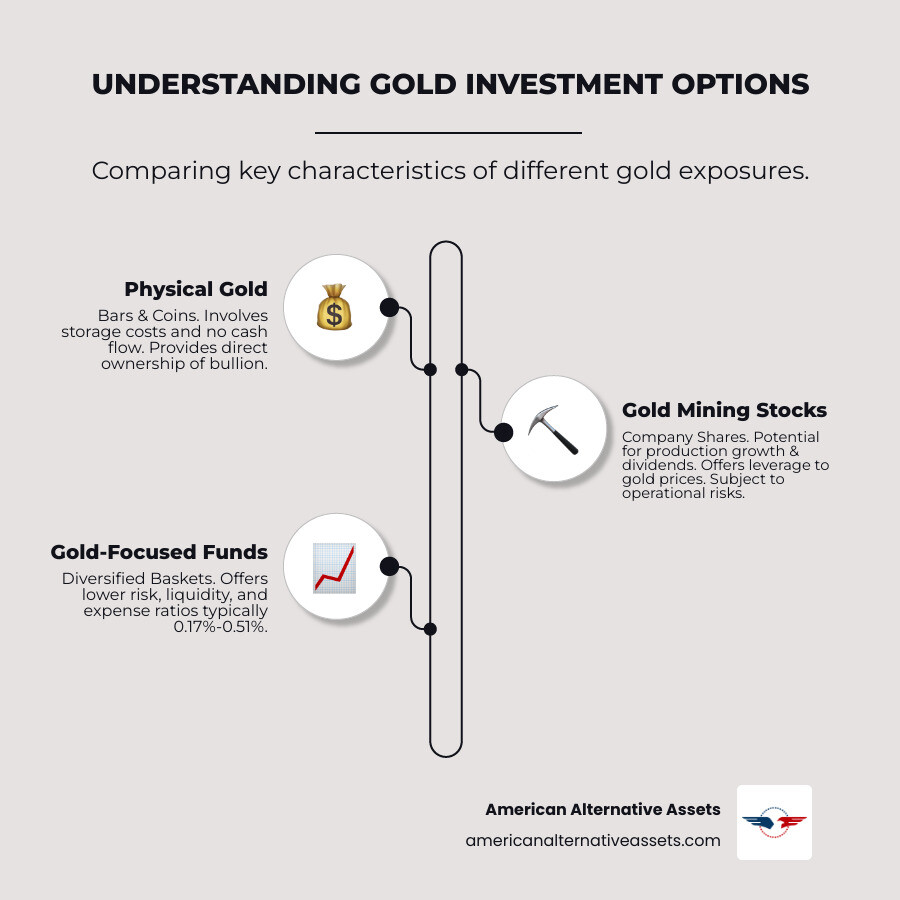
Gold Stocks vs. Physical Gold
While both offer exposure to gold’s price, gold stocks and physical gold are fundamentally different. Gold stocks and ETFs offer superior
liquidity, allowing instant trades during market hours, whereas selling physical gold takes time and effort. Physical gold also incurs
storage and insurance costs, which are non-existent for stocks held in a brokerage account.
Crucially, physical gold generates no cash flow. In contrast,
owners of a business — such as a gold miner — can profit not only from the rising price of gold but also from the business itself. Mining companies can pay dividends and reinvest profits to grow, offering
leverage that physical bullion lacks. A 10% rise in gold prices might lead to a 15-20% rise in a well-run miner’s stock.
Determining Your Portfolio Allocation
How much of your portfolio should be in gold stocks? Most financial advisors suggest a conservative allocation of
5% to 15% of your net worth, according to experts like Scott Travers. This can be adjusted based on your risk tolerance and financial goals. Since gold can be volatile, a longer time horizon is beneficial.
Remember to
rebalance periodically to keep your allocation in line with your target. As markets shift, your gold holdings may grow or shrink as a percentage of your portfolio, requiring adjustments to maintain your desired strategy.
At American Alternative Assets, we view gold as a stabilizer—a protective element for your wealth. It’s there to provide real privacy and protection when other investments might be struggling.
Are gold-focused investment vehicles a good way to start investing in gold stocks?
Yes, for most beginners, gold-focused ETFs are an ideal entry point. They offer simplicity, instant diversification, and low costs, removing the need to become an expert on individual mining companies. With expense ratios as low as 0.1% for funds like the SPDR Gold MiniShares (GLDM), they provide an accessible and cost-effective way to gain exposure to the gold sector. The popularity of these funds, which have grown to hold over $286 billion in assets since 2004, demonstrates their effectiveness for millions of investors.
Frequently Asked Questions about Gold Stock Investing
Is a gold stock a good long-term investment?
Gold stocks can be excellent long-term investments, but their success depends on both gold price trends and company-specific factors. While their value is linked to the commodity price, a well-managed mining company can create additional value through efficient operations, production growth, and dividends. Gold prices move in cycles, but quality companies can deliver returns even when gold prices are flat. Long-term success hinges on choosing strong companies and viewing gold stocks as one component of a diversified portfolio.
Gold mining stocks are leveraged to the price of gold, meaning they can outperform the metal during price rallies. Because their production costs are relatively fixed, a rising gold price can dramatically expand their profit margins, leading to outsized stock returns. However, they can also underperform due to operational issues like cost overruns, regulatory challenges, or poor management. Their performance is not perfectly correlated with the spot price of gold; they offer higher potential returns but also introduce company-specific risks.
What is the difference between a gold-backed investment and a gold mining investment?
This is a key distinction.
Gold-backed investments, like certain ETFs, hold physical gold and are designed to track its price directly. Your shares represent ownership in bullion stored in a vault. They offer pure, simple exposure to the commodity’s price movements.
Gold mining investments are shares in companies that produce gold. As
owners of a business—such as a gold miner—can profit not only from the rising price of gold but also from the business itself, your returns depend on both gold prices and company performance. A well-run miner can pay dividends and grow, while a poorly-run one can lose money even if gold prices rise. Understanding this difference is crucial to finding the
best way to invest in gold stocks for your goals.
There is no single
best way to invest in gold stocks; the right approach depends on your goals and risk tolerance. We’ve explored individual mining stocks for direct control, streaming companies for lower-risk exposure, and gold-focused ETFs for simple, instant diversification. Each serves a different purpose, from aggressive growth to passive portfolio balancing.
The most important step is
doing your due diligence. Understand what you’re buying, decide on a suitable portfolio allocation (typically 5-15%), and align your strategy with your financial goals. Gold is not a get-rich-quick scheme but a long-term tool for wealth preservation and diversification.
At American Alternative Assets, we see precious metals as a vital form of protection for your wealth. While we specialize in helping clients invest in physical gold and silver through Precious Metals IRAs, we know a comprehensive strategy can include both physical assets and stocks. Our approach is built on
trust, transparency, and ethical practices. We provide white-glove, relationship-first service to help you make informed decisions that serve your financial future.
Whether you choose gold stocks, physical metals, or a combination, ensure the strategy fits your life and protects what you’ve worked hard to build.
Learn how to buy gold and silver to protect your wealth.