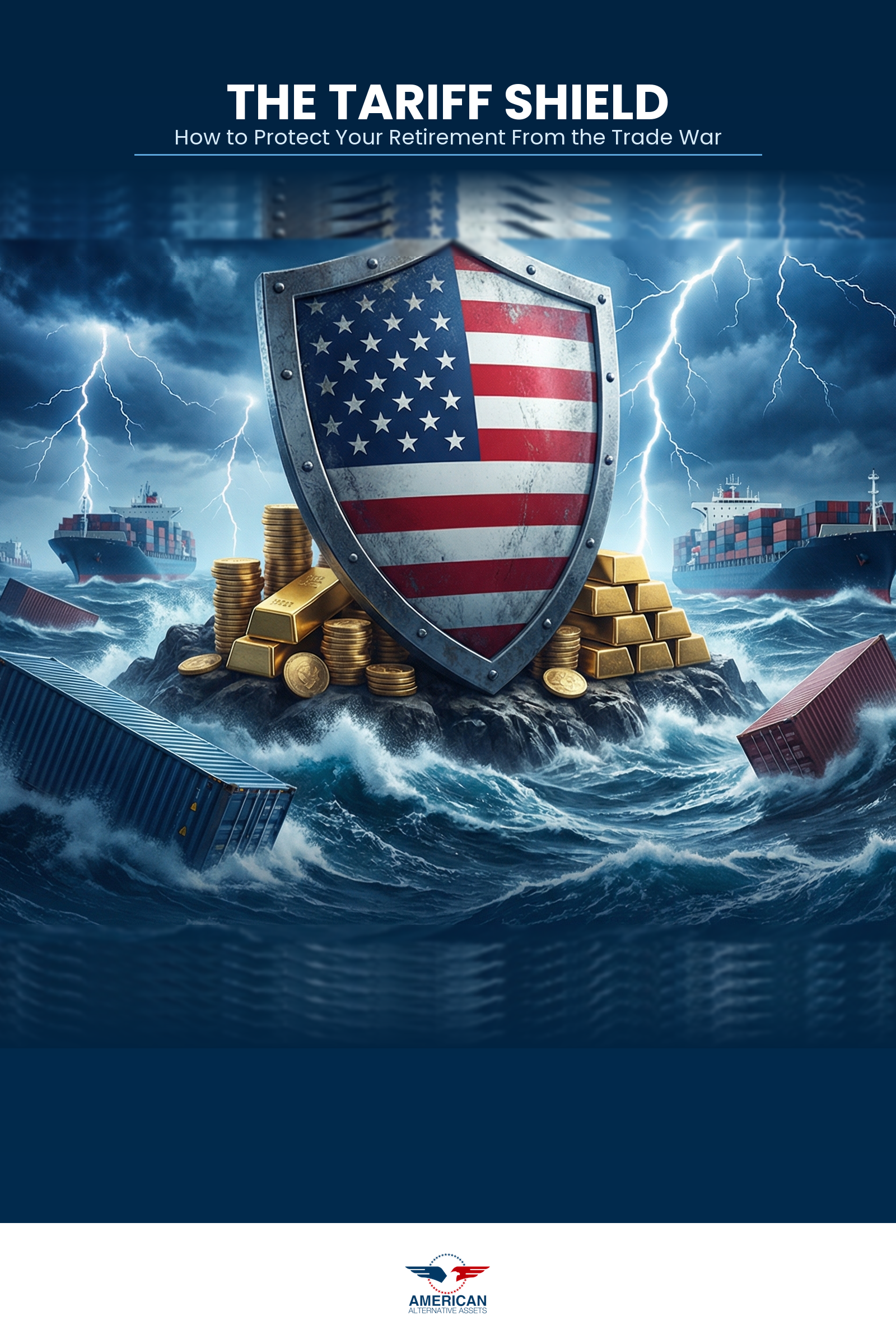
 The Tariff Shield
Click any chapter to jump directly to it.
A Letter from the Team at American Alternative Assets 3 Chapter 1: The Tariff Storm 4 Chapter 2: How Tariffs Hit Your Wallet 5 Chapter 3: Your 401(k) in the Crossfire 6 Chapter 4: The Gold Shield 7 Chapter 5: Silver — The Overlooked Opportunity 8 Chapter 6: Your 3-Step Tariff Protection Plan 9 Don't Let Tariffs Erode Your Retirement 10
The Tariff Shield
The Team at American Alternative Assets
Dear Friend,
On February 20, 2026, the financial landscape shifted overnight. The Supreme Court struck down President Trump's tariff program — and within hours, new tariffs were imposed under emergency authority.
By February 24, a 15% tariff on virtually all imports will take effect. Markets are whipsawing. Prices are rising. And millions of Americans are watching their retirement accounts hang in the balance.
If that concerns you, you're not alone — and you're not powerless.
We wrote this guide because we believe every American deserves a clear, honest roadmap for protecting their savings during a trade war. Not hype. Not panic. Just the facts — and a real plan.
At American Alternative Assets, we've helped thousands of Americans move over $2 billion in retirement savings into physical gold and silver — the assets that experts say tend to thrive during exactly the kind of turmoil we're seeing right now.
This guide will show you what's happening, why it matters to your money, and the specific steps you can take to protect yourself — starting today.
Read every page. Then call us. The tariffs take effect Monday. The time to act is now.
The Team at American Alternative Assets
The Tariff Shield
Here's what just happened — and why it matters more than almost anything in recent economic history.
On February 20, 2026, the U.S. Supreme Court struck down President Trump's sweeping tariff program, ruling it exceeded executive authority. For a brief moment, markets exhaled.
Then the hammer dropped.
Within hours, President Trump invoked Section 122 of the Trade Act of 1974 — an emergency provision that allows the president to impose tariffs of up to 15% for 150 days without Congressional approval. He immediately set a 10% tariff on all imports entering the United States.
The next day, February 21, that rate was raised to 15% — the maximum allowed under Section 122.
February 24, 2026The date the 15% global tariff takes effect. Every import — from electronics to food to raw materials — will cost more the moment it crosses the U.S. border.
This isn't the first time tariffs have shaken the economy.
The Smoot-Hawley Tariff Act of 1930 raised tariffs on over 20,000 imported goods. The result? Global trade collapsed by 65%. The Great Depression deepened. Economists nearly universally agree it was catastrophic.
In 2018-2019, the first round of Trump tariffs on China triggered a 20% S&P 500 decline in Q4 2018 and sent agricultural exports plummeting. Farmers needed $28 billion in government bailouts.
History's lesson is clear: Trade wars create uncertainty. Uncertainty creates volatility. Volatility destroys retirement portfolios. Every single time.
But this time is different — and potentially worse. A 15% tariff on all imports is broader and more aggressive than anything we've seen in modern history. It affects every sector, every supply chain, and every American consumer.
Let's look at exactly how this hits your wallet…
The Tariff Shield
Let's cut through the political noise and talk about what tariffs actually do to your everyday life.
A tariff is a tax on imported goods. But here's the part most people miss: the importer pays the tax, then passes the cost to you. Companies don't eat tariffs. Consumers do.
With a 15% tariff on all imports, here's what experts say you can expect:
$3,800+ Per YearEconomists estimate a 15% universal tariff could cost the average American household $3,800 or more per year in higher prices — hitting groceries, vehicles, electronics, clothing, and more.
Groceries. The U.S. imports roughly 15% of its food supply. Coffee, produce, seafood, and packaged goods will see immediate price increases. Fresh fruits and vegetables from Mexico and Central America? Up 15% overnight.
Vehicles. The average new car contains parts from 5-10 countries. A 15% tariff on imported components could add $2,000-$5,000 to the price of a new vehicle. Used car prices will follow.
Electronics. Your next smartphone, laptop, or TV is about to get more expensive. The vast majority of consumer electronics are assembled overseas. Experts suggest prices could jump 10-20% within months.
Here's the chain reaction:
Tariffs → Higher import prices → CPI rises → Purchasing power drops → Your retirement savings buy less.
The retirement math is brutal. If inflation rises just 2 additional percentage points because of tariffs, a retiree spending $5,000/month today will need $6,100/month in just 10 years to maintain the same lifestyle. That's $13,200 more per year — and that's on top of existing inflation.
But rising prices are only half the story. Your investment portfolio is under direct assault too.
The Tariff Shield
If you've checked your retirement account lately, you've probably noticed something unsettling: wild swings, day after day.
That's not a coincidence. Trade war uncertainty is poison for stock markets.
Here's why. The S&P 500 is heavily weighted toward companies with global supply chains — Apple, Amazon, Tesla, Walmart, Nike. When tariffs spike, these companies face:
The Whipsaw EffectSince the tariff crisis began, the S&P 500 has experienced dramatic daily swings. Experts say this volatility could persist for months as markets struggle to price in the full economic impact of a 15% global tariff.
Bonds aren't safe either. Rising inflation from tariffs pressures the Federal Reserve to keep rates elevated — or even raise them. Higher rates mean bond prices fall. The traditional "safe haven" of bonds may actually work against you in a tariff-driven inflationary environment.
The retirement account trap: Most 401(k)s and IRAs are invested almost entirely in stocks and bonds. That means your retirement is 100% exposed to the two asset classes most vulnerable to trade war fallout.
Consider this: During the 2018-2019 trade war (which was far less aggressive than today's), the S&P 500 dropped 20% in just 3 months. A $500,000 retirement account lost $100,000 in a single quarter. Today's tariffs are broader, higher, and more disruptive. The risks are significantly greater.
So what actually works during a trade war? What asset has historically protected wealth when tariffs, inflation, and volatility converge?
The answer has been the same for 5,000 years…
Our Gold IRA Specialists can review your current exposure and show you how to protect it — in one phone call.
(888) 814-7915Free consultation. No obligation. No pressure.
The Tariff Shield
There's a reason they call gold a "safe haven" — and right now, that reason is more relevant than it's been in decades.
Gold has one remarkable quality that makes it uniquely suited for trade wars: it's not imported, not taxed by tariffs, and not debased by any government.
While tariffs are raising the price of virtually everything that crosses a border, gold sits outside that system entirely. It's a borderless, universal store of value that no trade policy can diminish.
Gold Above $5,000/ozIn February 2026, gold has surged past the $5,000 mark — driven by trade war fears, inflation expectations, and massive central bank buying. Experts say the rally is far from over.
What the experts are saying:
Why does gold thrive during trade wars?
1. Inflation hedge. Tariffs drive prices higher. Gold has historically kept pace with — and often exceeded — inflation. When your dollars buy less, your gold buys more.
2. Safe haven demand. When markets become volatile and uncertain, investors flee to gold. Trade wars create exactly the kind of fear and uncertainty that drives gold prices higher.
3. Currency protection. Trade wars often weaken the dollar as trading partners retaliate and global confidence erodes. Gold is priced in dollars — when the dollar falls, gold rises.
The anti-tariff asset: While tariffs raise the cost of imported goods, increase business costs, and create market chaos — gold does the opposite. It benefits from every single consequence of a trade war. That's not opinion. That's history.
But gold isn't the only precious metal that experts say could benefit from this tariff environment…
The Tariff Shield
While gold gets the headlines, silver may be the bigger opportunity in a tariff-driven economy. Here's why.
Silver has a dual identity that no other precious metal shares. It's both a monetary metal (like gold) AND a critical industrial metal used in manufacturing, technology, and energy production.
That dual role creates a unique advantage in today's environment:
The Reshoring BoomTariffs are accelerating the push to bring manufacturing back to America. Every new factory, every solar installation, every electric vehicle built domestically requires silver — and lots of it.
Silver's industrial demand is surging:
Supply can't keep up. Above-ground silver inventories have been declining for years. Mining output has plateaued while industrial and investment demand continues to climb. Experts say this supply-demand imbalance could drive prices significantly higher.
The gold-to-silver ratio currently sits near 85:1 — far above the historical average of roughly 50:1. Many analysts suggest this means silver is significantly undervalued relative to gold and could see outsized gains as the ratio normalizes.
The tariff connection: As tariffs push companies to reshore manufacturing to the U.S., domestic demand for silver will accelerate. At the same time, silver's role as a safe-haven metal means it benefits from the same fear and uncertainty driving gold. Silver gets a double tailwind.
So how do you actually put this knowledge to work? Let's build your protection plan…
The Tariff Shield
You don't need to be an economist to protect your retirement from tariffs. You just need three smart moves — and you can start today.
Look at your current portfolio. What percentage is invested in stocks of companies with global supply chains? If your 401(k) or IRA holds S&P 500 index funds, the answer is likely 70-80% or more.
These companies are directly exposed to tariff costs, supply disruptions, and retaliatory trade actions. Your retirement is riding on their ability to navigate a trade war — and many won't.
Ask yourself: What percentage of my retirement is protected from tariff fallout? If the answer is close to zero, it's time for Step 2.
A Gold IRA allows you to hold physical gold and silver inside a tax-advantaged retirement account. You can roll over funds from your existing 401(k), IRA, 403(b), or TSP — tax-free and penalty-free.
Here's how it works: Your existing retirement funds are transferred directly to a self-directed IRA custodian. You then use those funds to purchase IRS-approved physical gold and silver, which is stored in a secure, insured depository. No tax event. No penalties. No disruption to your retirement plan.
The process takes 7-14 business days. AAA handles all the paperwork.
Our Gold IRA Specialists will review your current portfolio, identify your tariff-vulnerable holdings, and recommend a personalized precious metals allocation based on your specific situation, timeline, and goals.
Many experts suggest diversifying a portion of your portfolio into precious metals — especially given current conditions. Your specialist will help you find the right allocation.
There's no cost. No obligation. And no pressure. Just a clear-eyed assessment of your exposure and a plan to address it.
Tariffs Hit MondayThe 15% global tariff takes effect February 24. Markets will react. Prices will rise. The time to prepare is before it happens — not after.
Call now. Get your free tariff protection consultation before the deadline hits.
(888) 814-7915Thousands of Americans are already protected. Join them.
The 15% global tariff takes effect Monday. Your window to prepare is closing.
You've seen the facts. Tariffs drive inflation. Inflation erodes purchasing power. Markets whipsaw. And your retirement account is caught in the middle.
Gold and silver have shielded wealth through every trade war in history. This one is no different.
(888) 814-7915Call now for your FREE Tariff Protection Consultation with a Gold IRA Specialist.
In just 15 minutes, you'll discover:
✓ How exposed your current portfolio is to tariff risk
✓ The right gold & silver allocation for your situation
✓ How to roll over your 401(k) or IRA tax-free — starting this week
American Alternative Assets has helped thousands of Americans protect over $2 billion in retirement savings.
BBB Accredited • A+ Rating • Trusted by clients in all 50 states